
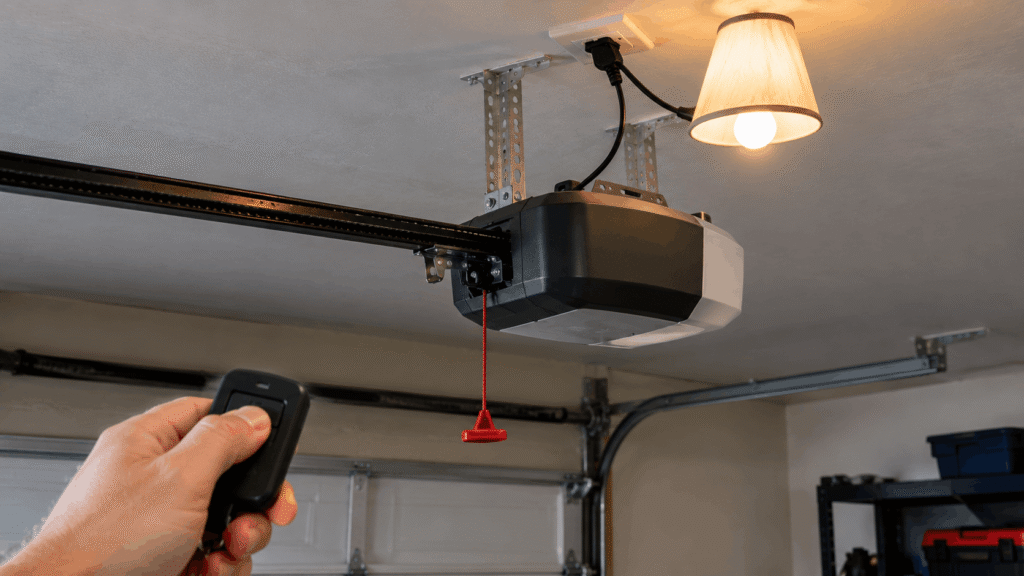
You press the remote, then the wall button, and the opener stays completely dark and silent, even though the outlet you tested runs a lamp fine. That combination usually points to a fixable break somewhere between the outlet and the opener’s control board, and you can trace it in about 10 minutes.
Quick Answer: A garage door opener with no power when the outlet works usually has a problem between the plug and the logic board. Check, in order: the outlet the opener actually uses (often a GFCI-protected ceiling outlet), the plug and cord, a 30-second unplug reset, then the fuse, transformer, or control board. Call a pro for board or capacitor work.
Table of Contents
What You Need to Know
- The outlet you tested may not be the outlet the opener uses, and a tripped GFCI can kill it while the panel breaker looks normal.
- Work in order: outlet, plug, cord, fuse or overload, signs of life, board, capacitor.
- A bad capacitor rarely makes an opener totally dead. It usually hums without moving.
- Unplug before touching anything, and never open the housing. Capacitors and boards can hold a charge.
- Board, capacitor, and wiring repairs are pro work.
Why Does My Garage Door Opener Have No Power When the Outlet Works?
The opener is usually losing power at a point you haven’t tested yet. The most common gap is that the working outlet and the opener’s outlet are two different receptacles, often on different protected circuits.
Openers typically plug into a ceiling outlet, while people test a wall outlet with a phone charger. A GFCI (ground fault circuit interrupter) is an outlet or breaker that cuts power when current leaks to ground, used to prevent shock. The 2020 National Electrical Code requires GFCI protection for garage receptacles in dwelling units, as summarized in this IAEI guide to NEC Section 210.8. Local adoption of the code varies, so older homes may differ. One GFCI can protect several outlets, so the tripped one may sit on another wall or outside the house.
Past the outlet, the usual culprits are a loose or damaged plug and cord, a blown fuse or tripped overload protector on some models, or a failed transformer or control board.
Is It Really Dead? No Power vs. Power but No Response
Confirm which problem you have first, because they lead to different fixes. Total silence with no lights points to a power path problem; a hum or click points to the motor side.
| What you see | Likely meaning | Go to |
|---|---|---|
| No light, no LED, no click, no hum | Power isn’t reaching the board | Checks 1–6 below |
| Wall control dark too | Transformer or board failure | Check 6 |
| Hum or click, door doesn’t move | Motor or capacitor problem | Check 7 |
| Lights and lit wall control, door won’t respond | Has power, different fault | opener problems guide |
Follow the Power: 7 Checks in Order
Start at the outlet and move toward the opener, because each check rules out one link in the power path. Unplug the opener before any hands-on check.
| Check | Test | If power is present | If not |
|---|---|---|---|
| 1 | Test the outlet the opener uses | Go to check 2 | Find the tripped GFCI or breaker |
| 2 | Unplug 30 seconds, reseat plug | Resolved, or go to 3 | Go to 3 |
| 3 | Inspect cord and plug | Go to 4 | Replace cord (pro) |
| 4 | Check fuse or overload (model-dependent) | Go to 5 | Replace fuse per manual |
| 5 | Any LED, click, or hum from the unit? | Go to 6 | Board or transformer: pro |
| 6 | Hum but no motion? | Capacitor suspect: pro | Board or motor: pro |
Save or screenshot this Follow-the-Power Triage Table. It covers every check in order, from the outlet to the capacitor.
1. Test the Exact Outlet the Opener Uses
Plug a lamp or a plug-in outlet tester into the exact ceiling receptacle the opener uses. With a multimeter, a live U.S. outlet reads about 120 volts.
Also confirm the opener is plugged directly into that outlet, not into one controlled by a wall switch or timer. Chamberlain’s own no-power diagnostic, written for an opener with no lights, sound, or movement, starts by confirming it is plugged directly into a working outlet with no switches or timers. See Chamberlain’s no-power troubleshooting steps.
If the outlet is dead, press TEST then RESET on every GFCI in the garage, on the outside of the house, and in nearby bathrooms or utility areas. According to the Electrical Safety Foundation International (ESFI), a GFCI is checked by pressing RESET, plugging in a nightlight, pressing TEST so the light goes out, then pressing RESET so it comes back. See ESFI’s GFCI testing steps.
A GFCI can trip while the panel breaker stays ON. A tripped breaker also often sits halfway between ON and OFF, so push it fully OFF, then ON.
2. Unplug and Reseat
Unplug the opener, wait 30 seconds, then push the plug in firmly. Vibration can loosen a plug over time, and a short wait can clear a glitched control board on some models.
Check your manual for the exact wait time your brand recommends.
3. Inspect Cord and Plug
With the opener unplugged, run your hand along the cord and check the plug blades. Look for crushing from stored items, cuts, bent blades, or brown scorch marks.
Any heat damage means stop and call a pro. Don’t reuse a scorched plug or outlet.
4. Check Fuse and Overload Protection
Read your manual to see whether your model has a fuse or a thermal overload. Some openers shut down after overheating and restore themselves once cool.
If a fuse has blown, replace it only with the same amp rating printed on the old one. A larger fuse removes protection, and a fuse that blows again means something deeper is wrong.
5. Look for Signs of Life in the Unit
Press the wall button and watch, listen, and feel for any reaction. An LED on the motor head, a relay click, or a hum all mean power is reaching part of the system.
A dark wall control is another clue, since the board powers it.
If any LED or flashing arrow appears, the opener has power and is reporting a fault, so leave this article’s power checks and look up the code. Chamberlain’s support hub covers diagnostic codes and flashing UP/DOWN arrows, which signal that the opener has detected an issue. Use its garage door opener diagnostic codes if you own a Chamberlain or LiftMaster. For other brands, check your manual.
6. Suspect the Logic Board or Transformer
If the outlet is live and the unit shows no life at all, the internal power supply is the likely fault. A transformer steps the outlet’s 120 volts down to the low voltage the board and wall control use.
Power surges from storms are a frequent cause of board failure. Don’t open the housing yourself, because a board can hold a charge after unplugging.
7. Suspect the Motor Capacitor
A hum or click with no movement points to the capacitor, covered next. This is a different fault from a totally dead opener.
Want the 60-second version of these checks? Grab the printable Follow-the-Power checklist to tape inside your garage. [EMAIL CAPTURE: form/link]
Bad Garage Door Opener Capacitor: Symptoms and Cost
A motor capacitor stores charge and gives an AC induction motor the boost it needs to start. A failing capacitor usually leaves the lights and wall control working while the motor hums without turning.
That makes it different from the no-power problem in this article. Symptoms owners commonly describe:
- A hum or click when you press the button, with no door movement
- A motor that runs weakly or slowly
- Repeated overload shutdowns
When a capacitor fails, the motor can’t develop starting torque, so it strains and can overheat.
Capacitors are generally found on older AC-motor openers, and DC-motor units generally don’t use one. A replacement must match the µF and voltage rating stamped on the original.
Cost varies with the opener model, the part rating, and labor, so ask for a quote that lists part and labor separately. Capacitors can hold a charge after unplugging, so leave this to a pro.
When to Stop and Call a Pro
Stop and get a technician or electrician if any of these show up:
- A burning smell, sparks, or a scorched plug or outlet
- A breaker that keeps tripping after you reset it
- A swollen or leaking part, or any need to open the housing
- A dead unit after check 6, or a suspected capacitor or board fault
Never touch the door’s springs, cables, or bottom brackets. They carry high tension and cause serious injuries. If you need the door open in the meantime, pull the red emergency release cord with the door fully closed.
Repair or Replace?
Repair makes sense for a single low-cost fix such as a cord, fuse, or reseated plug. Replacement deserves a look when the opener is old, parts are scarce, or a repair quote climbs close to the price of a new unit.
Once you know what failed, compare the quote with the cost of a new opener. [CONTENT GAP: opener replacement / buying guide]
After Power Returns: Reset and Reprogram
Once the opener powers up, run the door through a full open-and-close cycle and check the light. Test the wall control, remotes, and keypad, since some models lose programming after a power loss.
If the loss was a grid outage, see the power outage recovery steps. Also test the safety reversal, which most manuals describe as laying a 1½-inch board (a 2×4 flat) under the door to confirm it reverses on contact.
Common Mistakes That Waste an Hour
- Testing the wrong outlet. A working wall outlet says nothing about the ceiling receptacle.
- Checking only the panel. A tripped GFCI leaves the breaker looking normal.
- Ignoring a switched outlet. An outlet on a wall switch or timer can cut power to the opener without any tripped device.
- Fitting a bigger fuse. A larger rating removes the protection and hides the real fault.
- Using an extension cord as a permanent fix. Many manuals advise against it, so check yours.
- Opening the housing with the unit plugged in. Charged components make this dangerous.
FAQs
Why is my garage door opener not working but has power?
When the opener has power, the fault is usually in the safety sensors, a wall control lockout, the remote, the motor, or a capacitor. Check whether the photo-eye LEDs are lit and steady, and whether the wall control has a lock mode switched on. See our opener problems guide for those checks.
Why is my garage power out but the breaker is not tripped?
A GFCI outlet or breaker can trip on its own while the main panel breaker still looks ON. Press TEST then RESET on every GFCI in the garage and outside. Also check that a tripped breaker isn’t sitting halfway between ON and OFF, which looks nearly identical to ON.
Why don’t I have power to my garage door opener?
Common causes are a tripped GFCI, a loose or damaged plug and cord, an outlet controlled by a switch or timer, a blown fuse on some models, or a failed transformer or control board. Test the ceiling outlet the opener actually uses with a lamp or outlet tester before assuming the opener itself has failed.
What are the symptoms of a bad capacitor on a garage door opener?
The two typical signs are a motor that hums or clicks without moving the door, and a motor that runs weakly or slows down. Lights and the wall control often still work, which separates a capacitor fault from a completely dead opener with no power.
Will unplugging a garage door opener reset it?
On many models, unplugging for about 30 seconds and plugging back in clears a glitched control board and reseats a loose plug. It won’t fix a blown fuse, failed board, or bad capacitor. Follow your manual for the exact wait time on your model.
What to Do Next
- If the opener powered back up but acts odd, walk through the power outage recovery steps.
- To troubleshoot an opener that has power but won’t respond, read 9 common opener problems and fixes.
- If the repair quote makes a new opener look smarter, [CONTENT GAP: opener replacement / buying guide].