
You’re standing in front of a wall of garage door openers—or a spec sheet for the one you already own—and every listing throws a different horsepower number at you: 1/2 HP, 3/4 HP, 1 HP, or a DC motor claiming “HP equivalent.” None of it tells you what your door actually needs. Here’s the straight answer, with the numbers that matter for your specific door.
Quick Answer: Most single-car garage doors (up to 8 feet wide) run fine on a 1/2 HP opener. Double-car doors (16 feet wide) or heavier doors—wood, insulated steel, or carriage-style—need 3/4 HP to 1 HP. Weight and material matter more than door count.
Table of Contents
What You Need to Know
- A 1/2 HP opener handles most single-car doors under 400 lbs.
- A 3/4 HP to 1 HP opener is the safer choice for double-car doors, insulated doors, or wood doors.
- DC motor “HP” ratings are often marketing equivalents, not measured shaft horsepower — check the manufacturer’s lift-force spec instead.
- Door weight and material, not just door count, determine the horsepower you actually need.
- An underpowered opener strains, reverses randomly, or runs slower over time—and it’s often mistaken for a broken opener when the real fix is a stronger motor or a spring adjustment.
1/2 HP vs 3/4 HP vs 1 HP: What’s the Real Difference?
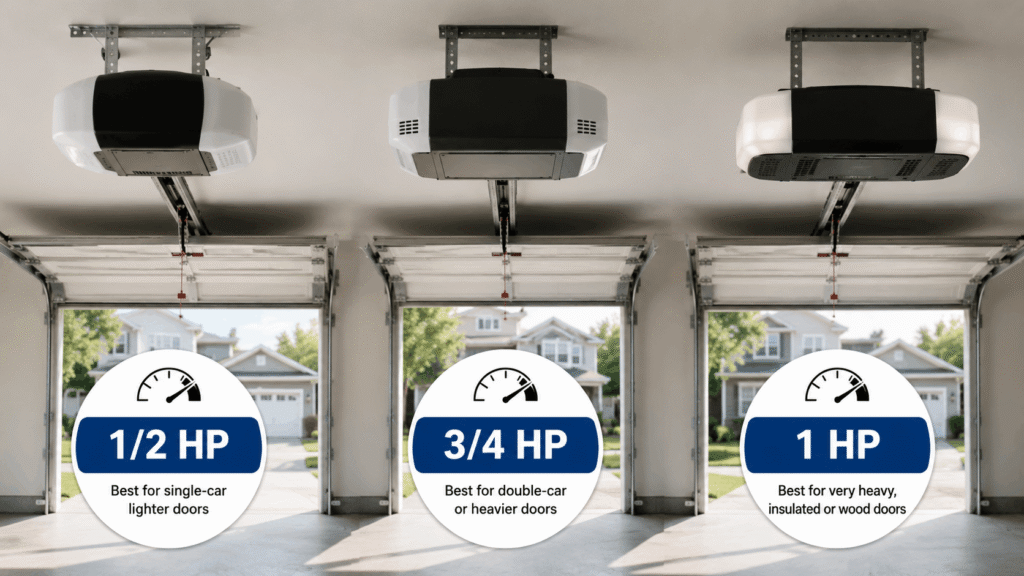
The horsepower rating measures how much sustained lifting force the motor can produce without straining. A 1/2 HP motor is built for lighter, smaller doors; 3/4 HP and 1 HP motors handle heavier and larger doors with less wear on the motor over time.
The jump from 1/2 HP to 3/4 HP isn’t just “more power for bigger doors”—it”‘s about margin. A 1/2 HP opener rated right at the edge of your door’s weight will work, but it’ll run hotter and wear out faster than a 3/4 HP unit doing the same job with room to spare.
Is 1/2 HP Enough for a 2-Car Garage?
Usually not, if the door is a single 16-foot-wide panel. A double-wide door has significantly more surface area and weight than two single doors combined into one panel, and a 1/2 HP motor pushed to its limit shortens both the motor’s life and the door’s smooth operation. For a single 16-foot door, 3/4 HP is the safer baseline; 1 HP is worth it for insulated or wood doors.
If your “2-car garage” actually has two separate single doors, each on its own opener, 1/2 HP per opener is typically fine—you’re back to single-door math.
Garage Door Opener Horsepower Chart by Door Size & Weight
| Door Type | Approx. Width | Approx. Weight | Recommended HP | Common Drive Types |
|---|---|---|---|---|
| Single steel (non-insulated) | 8–9 ft | 130–180 lbs | 1/2 HP | Chain, belt |
| Single insulated steel | 8–9 ft | 180–250 lbs | 1/2 HP – 3/4 HP | Chain, belt |
| Single wood/carriage-style | 8–9 ft | 250–350 lbs | 3/4 HP | Chain, screw |
| Double steel (non-insulated) | 16 ft | 250–350 lbs | 3/4 HP | Chain, belt |
| Double insulated steel | 16 ft | 350–450 lbs | 3/4 HP – 1 HP | Chain, belt, screw |
| Double wood/carriage-style | 16 ft | 450+ lbs | 1 HP | Chain, screw |
Save or screenshot this horsepower chart — it covers the most common residential door sizes and materials so you can match a door to a motor without guessing at the store.
Door weight varies by manufacturer, panel thickness, and window/hardware add-ons, so treat these as planning ranges, not exact specs for your door.
Why DC Opener “Horsepower” Numbers Are Different (HP-Equivalent Explained)
Many modern DC-motor openers list an “HP-equivalent” rating instead of a directly measured horsepower figure because DC motors are rated by comparative lifting force rather than the same mechanical standard used for older AC motors. This is the part of the spec sheet that trips up the most shoppers.
An AC motor’s horsepower is a fairly direct measure of mechanical output. A DC motor’s “1.25 HP equivalent” label is a marketing comparison meant to tell you it lifts about as much as a 1.25 HP AC unit — not that it’s literally producing 1.25 mechanical horsepower.
This isn’t a flaw in DC openers—DC motors typically run quieter and offer smoother start/stop control than AC motors. It just means comparing two openers by their HP number alone can be misleading if one is AC and one is DC. Compare the manufacturer’s stated lift force in pounds for an apples-to-apples check, as detailed on Garage Door Opener Motor Types Explained.
Does Horsepower Actually Matter, or Is It Marketing?
Horsepower matters, but only relative to your specific door’s weight and material—more horsepower than your door needs adds cost without adding benefit. An oversized motor on a light door doesn’t make it safer or faster; it just runs underused.
Where horsepower genuinely matters is longevity and consistency. A correctly matched or slightly oversized motor lifts your door without straining, which means fewer reversals, less motor heat, and a longer service life for both the opener and the drive mechanism.
Signs Your Opener Is Underpowered
Before assuming your opener is broken, check whether these underpowered symptoms match what you’re seeing:
- The door reverses partway up. When the motor hits resistance, it can’t push through, and the safety system kicks in.
- The opener runs noticeably slower than it used to. A straining motor loses speed under load over months, not overnight.
- You hear a labored, higher-pitched motor sound. This is the motor working past its comfortable capacity.
- The door struggles more in cold weather. Lubricant thickens and hardware tightens slightly in the cold, adding resistance that an underpowered motor can’t absorb.
One counterintuitive fact: a struggling opener is more often a sign of a misadjusted torsion spring than an underpowered motor. Springs carry the bulk of a garage door’s weight—the opener only manages the last bit of lift and the horizontal motion. If your opener strains on a door that used to open smoothly, a spring check often solves it faster and cheaper than a motor upgrade.
Does Drive Type (Chain, Belt, or Screw) Change the HP You Need?
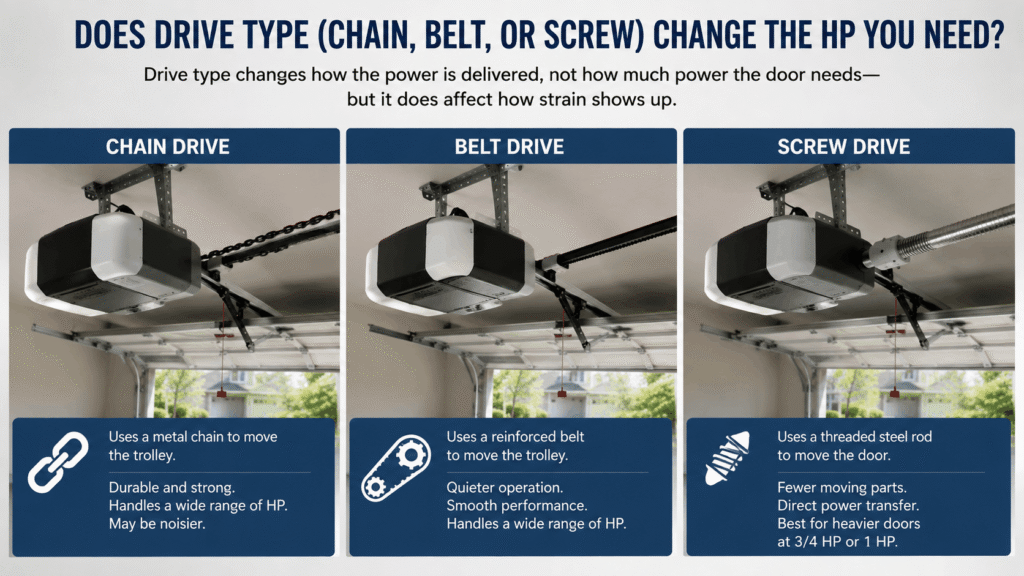
Drive type changes how the power is delivered, not how much power the door needs — but it does affect how strain shows up. Chain and belt drives use a trolley system that can handle a wide HP range comfortably. Screw drives connect more directly to the motor shaft, which is why heavier doors are often paired with screw-drive systems at 3/4 HP or 1 HP.
For a full comparison of how chain, belt, and screw drives perform and which suits different door types, see Types of Garage Door Openers: A Complete Comparison.
Common Mistakes When Choosing Opener Horsepower
- Matching HP to door count instead of door weight. Two single doors and one double door of the same total width don’t weigh the same or need the same motor.
- Comparing AC and DC horsepower ratings directly. Check lift force in pounds instead, especially when cross-shopping brands.
- Assuming a stronger motor fixes a spring problem. If the door is hard to lift by hand with the opener disconnected, that’s a spring issue a bigger motor won’t solve.
- Ignoring insulation weight. An insulated steel door can weigh 30–50% more than the same door uninsulated, which is enough to bump the recommended HP up a tier.
When to Call a Garage Door Professional Instead of Guessing
If your door is hard to lift by hand with the opener disconnected, that’s a spring or balance issue, not a horsepower issue, and it’s worth a professional inspection before buying a new motor. Springs under tension are also a genuine safety risk to adjust yourself to. If you’re unsure whether your symptoms point to motor strain or a mechanical problem, a garage door technician can diagnose it in minutes with the opener still attached—which saves you from replacing a motor that wasn’t the problem.
Get the Printable HP Cheat Sheet.
If you’re about to shop for an opener, save yourself the spec sheet confusion—sign up for our newsletter and get the printable Garage Door Opener Horsepower Cheat Sheet so you can check door type against recommended HP without pulling this guide up again.
FAQs
How much horsepower do I need on a garage door opener?
Most single-car doors need 1/2 HP; double-car or heavier doors (wood, insulated steel) need 3/4 HP to 1 HP. Door weight and material matter more than door count, so check your door’s approximate weight against the chart above before buying rather than assuming based on width alone.
Should I get a 1/2 HP or 3/4 HP garage door opener?
Choose 1/2 HP for a single, non-insulated steel door under roughly 250 lbs. Choose 3/4 HP for insulated single doors, wood doors, or standard double-car doors. When your door sits near the weight boundary between the two, 3/4 HP gives the motor more margin and typically lasts longer under regular use.
Does garage door opener horsepower matter?
Yes, but only relative to your door’s weight—more horsepower than your door needs doesn’t add speed or safety; it just runs underutilized. Matching horsepower to door weight and material is what actually affects motor strain, noise, and how long the opener lasts.
Why does my DC opener list an “HP-equivalent” instead of a regular HP number?
DC motors are rated by comparative lifting force rather than the same mechanical measurement AC motors use, so “HP-equivalent” is a marketing comparison, not a literal horsepower figure. Compare stated lift force in pounds instead of HP numbers when cross-shopping AC and DC openers.
What happens if my garage door opener is underpowered?
An underpowered opener strains under load, which shows up as partial reversals, a slower lift speed over time, a labored motor sound, or worse performance in cold weather. Left unaddressed, the strain shortens the motor’s lifespan and can trip the safety-reversal system more often.
What to Do Next
Not sure your door and opener are even matched up correctly to begin with? Start with What Is a Garage Door Opener? How It Works, Safety Features & Expert Tips for the fundamentals.
If you’re still deciding between AC and DC motors for your next opener, Garage Door Opener Motor Types Explained breaks down how each one performs.
And if a chain, belt, or screw drive is the piece you haven’t settled on yet, Types of Garage Door Openers: A Complete Comparison walks through which drive fits which door.