
Your garage door opener just died, or you’re standing in the aisle at Home Depot staring at three boxes that all claim to be “the “best” and none of them explain what’s actually different inside. That confusion ends here.
Quick Answer: Garage door openers use five motor/drive types — chain, belt, screw, direct drive, and jackshaft. Chain drives are the cheapest and loudest; belt drives are quiet but cost more; screw drives sit in the middle; direct drive and jackshaft motors serve specific setups (whisper-quiet rooms and low-headroom garages, respectively). Most single-car doors need 1/2 HP; double or insulated doors usually need 3/4–1 HP.
Table of Contents
What You Need to Know
- There are 5 common motor types, not 3 — chain, belt, screw, direct drive, and jackshaft.
- The drive mechanism (what actually moves the trolley) determines noise level and price, not the horsepower rating.
- Horsepower and drive type are two separate decisions — you need to get both right.
- Belt drive is the standard pick for anyone with a bedroom or living space above or next to the garage.
- Jackshaft motors mount on the wall next to the door, not the ceiling—the fix for low-headroom garages.
What Are the Main Types of Garage Door Opener Motors?
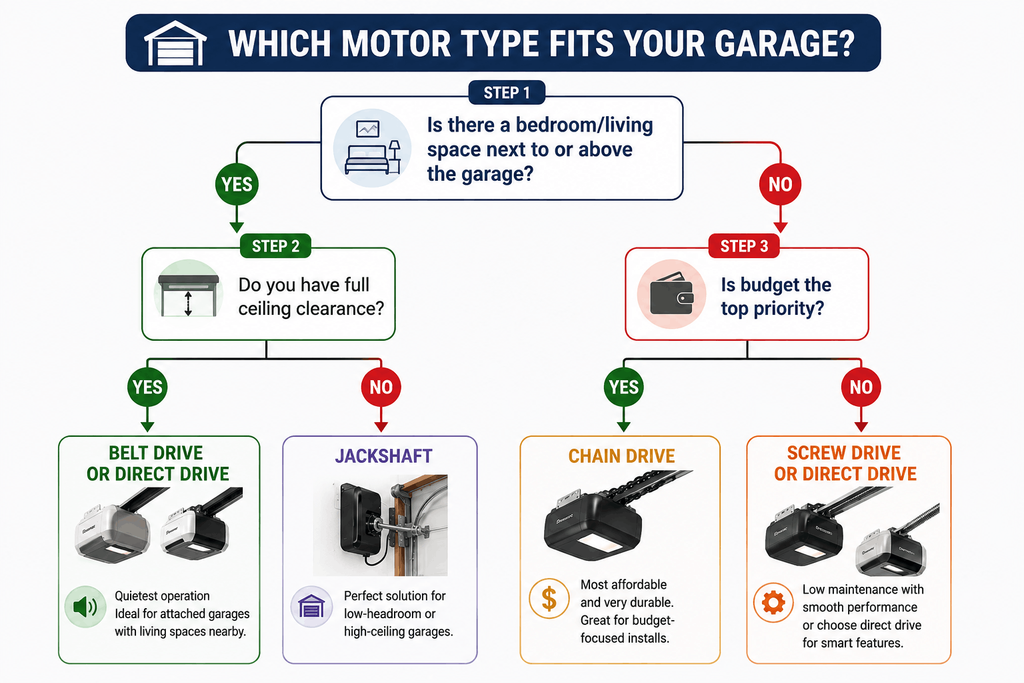
Garage door opener motors fall into five categories, and the difference between them is the mechanism that pulls the trolley along the rail — not the motor itself. The drive mechanism is what determines how loud, how fast, and how expensive the opener is, far more than the horsepower number on the box.
Motor type, mechanism, and noise level Typical price range Best for chain drive The metal chain pulls the trolley loudly. Detached garages, budget installs Belt drive: Rubber/fiberglass belt pulls trolley Quietest$$$Attached garages, bedrooms nearby Screw drive: a threaded steel rod turns a trolley. Moderate $$: Fewer moving parts, less maintenance. The direct drive motor itself travels the rail. Very quiet. New construction, tech-forward homes, Jackshaft Wall-mounted, no overhead rail Moderate $$$ Low-headroom or high-ceiling garages
Save or screenshot this motor comparison table—it covers every common residential setup and is the fastest way to narrow your options before you shop by price alone.
Chain Drive Motors
A chain drive uses a metal chain, similar to a bicycle chain, to pull the trolley that opens and closes your door. It’s the most affordable and most durable option under heavy use, which is why it dominates the budget end of the market.
The trade-off is noise. Metal-on-metal contact means chain drives are the loudest of the five types — a real problem if your garage sits under or next to a bedroom. For detached garages or anyone prioritizing cost and longevity over quiet operation, chain drive remains the default choice for a reason: it’s been the industry standard for decades, and parts are everywhere.
Belt Drive Motors
A belt drive replaces the chain with a rubber, polyurethane, or fiberglass-reinforced belt. This single material swap is what makes belt drives 40–50% quieter than chain drives in most manufacturer testing.
That quiet comes at a price premium—typically $50–$150 more than a comparable chain-drive unit. For attached garages, especially with a bedroom, home office, or nursery on the other side of the wall, that premium usually pays for itself in the first month of not waking anyone up at 6 a.m.
Screw Drive Motors
A screw drive uses a threaded steel rod that the trolley rides along, turned directly by the motor. Fewer moving parts than a chain or belt system means less to lubricate and less to wear out over time.
Noise sits between chain and belt—quieter than a chain, not as silent as a belt. Screw drives are sensitive to temperature swings, which can affect operating speed in very hot or very cold climates, so they’re a stronger fit in moderate climates than in extreme ones.
Direct Drive Motors
In a direct-drive system, the motor itself travels along a fixed chain or rail instead of pulling a trolley—there’s no separate belt or chain doing the work of translating motor rotation into linear motion. This design has the fewest moving parts of any type and is the quietest option on the market, often used in premium smart-home installations.
Direct drive units also tend to include integrated cameras, Wi-Fi, and battery backup as standard rather than optional add-ons, which is part of why they sit at the top of the price range.
Jackshaft Motors (Low-Headroom Garages)
A jackshaft opener mounts on the wall beside the door and turns the torsion bar directly, instead of hanging from the ceiling like the other four types. This is the only motor type built specifically for garages without enough ceiling clearance for a standard rail-mounted opener—vaulted ceilings, storage racks, or a rail-blocking HVAC unit.
If you have a normal garage with a flat ceiling and clearance above the door, you don’t need a jackshaft opener—it’s a solution to a specific physical constraint, not an upgrade.
DC vs. AC Motors: Which Is Quieter and More Efficient?
Most modern garage door openers, across all five drive types above, use DC (direct current) motors rather than AC (alternating current) motors, and that shift is a bigger factor in noise and smoothness than the drive mechanism alone.
DC motors ramp up and slow down gradually—called “soft start/soft stop”—rather than jerking on and off like older AC units. They’re also what enables battery backup, since DC motors can run directly off a battery during a power outage. If you’re comparing two openers with the same drive type, checking whether the motor is DC or AC tells you more about real-world smoothness than the horsepower spec does.
How Much Horsepower Do You Actually Need?
Horsepower is about door weight, not motor quality—a bigger number doesn’t mean a better opener; it means a stronger opener for a heavier door. Matching horsepower to your actual door, not buying the highest number available, is what prevents premature motor burnout.
Door type typical weight Recommended HPSingle, non-insulated. Under 130 lbs, 1/2 HP, single, insulated; 130–190 lbs, 1/2–3/4 HP double, non-insulated; 190–280 lbs, 3/4 HP double, insulated; or oversized 280+ lbs, 3/4–1 HP (or 1.25 HP DC).
Save or screenshot this horsepower chart—it covers the sizing question most buyers get wrong by guessing instead of checking their actual door weight and dimensions.
An underpowered motor on a heavy door works harder on every cycle, which shortens its lifespan even if it technically “handles” the door for the first year or two. If you’re not sure of your exact door weight, most manufacturers list it on the door’s original spec sheet or the inside panel label—and getting that number before you buy prevents a return trip to the store.
We’ll cover exactly how to read your current setup and compare real opener models in our upcoming best garage door openers guide—worth bookmarking if you’re not ready to buy today.
Common Mistakes When Choosing a Motor Type
Buying based on horsepower alone and ignoring drive type is the single most common mistake — a 3/4 HP chain drive is still loud, no matter how strong it is. HP and drive type solve two different problems.
Assuming “quiet” always means belt drive. Direct drive motors are often quieter than belt drives, and screw drives with a well-lubricated rod can be quieter than a poorly maintained belt system.
Skipping the headroom verification Buyers with vaulted or low ceilings sometimes buy a standard rail opener, get it home, and discover it doesn’t physically fit—a jackshaft unit should have been the starting point.
FAQ
What are the different types of garage door motors?
There are five common types: chain drive, belt drive, screw drive, direct drive, and jackshaft. Chains and belts are the most widely installed; direct drive and jackshafts serve specific use cases like whisper-quiet operation or low-headroom garages. Each uses a different mechanism to move the door, which affects noise, price, and maintenance needs.
How do I know what garage door motor I need?
Start with two factors: your door’s weight (for horsepower) and your noise tolerance (for drive type). A single, non-insulated door usually needs 1/2 HP; a double or insulated door needs 3/4 HP or more. If noise matters—bedroom above or beside the garage—prioritize a belt or direct drive over a chain.
What are the three types of garage door openers?
“Three types” is outdated — most references to three (chain, belt, screw) miss direct drive and jackshaft, which are now common, especially in newer construction and low-headroom garages. Today’s market has five distinct drive types, each suited to a different setup.
Do I need 1/2 HP or 3/4 HP for my garage door opener?
Use 1/2 HP for a single, non-insulated door under roughly 130 lbs. Use 3/4 HP for a double door, an insulated single door over 130 lbs, or any door heavier than standard. When in doubt, size up—an opener working comfortably within its capacity lasts longer than one running at its limit.
What is a jackshaft garage door opener?
A jackshaft opener mounts on the wall next to the door and turns the torsion bar directly, rather than hanging from the ceiling like standard openers. It’s the standard solution for garages with vaulted ceilings, overhead storage, or any obstruction that blocks a normal rail-mounted unit.
What to Do Next
If you’re still deciding between opener categories broadly rather than motor mechanics specifically, our complete comparison of garage door opener types is the better starting point. For the fundamentals of how these systems work together, see how a garage door opener works. And if you’re brand new to the topic, a garage door opener covers the basics first.
This is a research-based comparison, not a substitute for checking your specific door’s weight rating with the manufacturer or consulting a professional installer before buying—especially on insulated or oversized doors where the wrong motor choice is costly to reverse.
Pingback: Garage Door Opener Making Noise But Not Moving – Fix Tips