
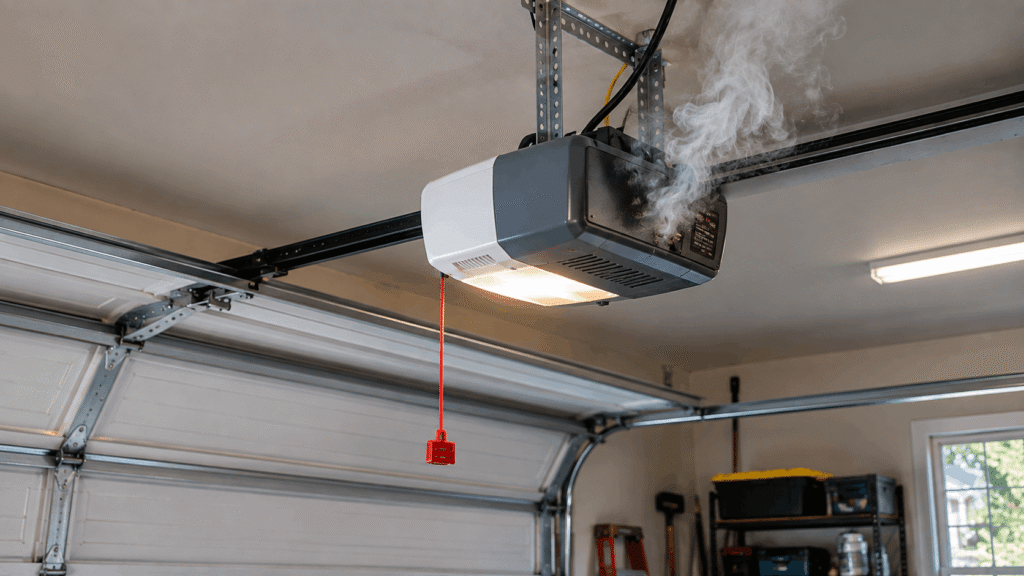
You just hit the button, and instead of the door opening, smoke started coming from the motor unit overhead. That’s not a normal noise or smell you can wait out — it’s a signal your opener needs your attention right now, and this guide will walk you through exactly what’s causing it and what to do next.
Quick Answer: Smoke from a garage door opener almost always means the motor is overheating or an internal electrical component — like a capacitor, transformer, or wiring — is failing. Stop using the opener immediately, unplug it, and don’t run the door again until you’ve identified the cause below.
What You Need to Know:
- Smoke means stop using the opener now — don’t try to “run it through” the cycle
- The most common causes are motor overheating, a failing capacitor, or worn drive-belt friction
- The type of smell (electrical burning vs. rubber vs. dust) tells you how urgent it is
- Most smoking-opener issues aren’t safe DIY repairs — electrical components carry shock and fire risk
- A garage door opener typically lasts 10–15 years; smoking is often a late-life failure sign
Is a Smoking Garage Door Opener a Fire Hazard?
Yes — visible smoke from any electrical appliance, including a garage door opener, means active overheating that can progress to arcing or ignition if left running. This isn’t hypothetical: in 2014, the U.S. Consumer Product Safety Commission recalled thousands of Genie garage door openers after their control boards were found to overheat and pose a fire hazard. The opener’s motor housing also sits close to wiring, wood framing, and stored items in most garages, which raises the stakes compared to smoke from an isolated appliance.
Unplug the unit at the outlet or breaker as soon as you see or smell smoke. FEMA’s electrical fire safety guidance is direct on this point: any appliance that smokes or gives off an unusual smell should be unplugged immediately and not used again until it’s been repaired. Don’t just stop pressing the remote — the transformer inside many openers stays energized even when the door isn’t moving, so leaving it plugged in doesn’t remove the risk.
Common Causes of Garage Door Opener Smoke
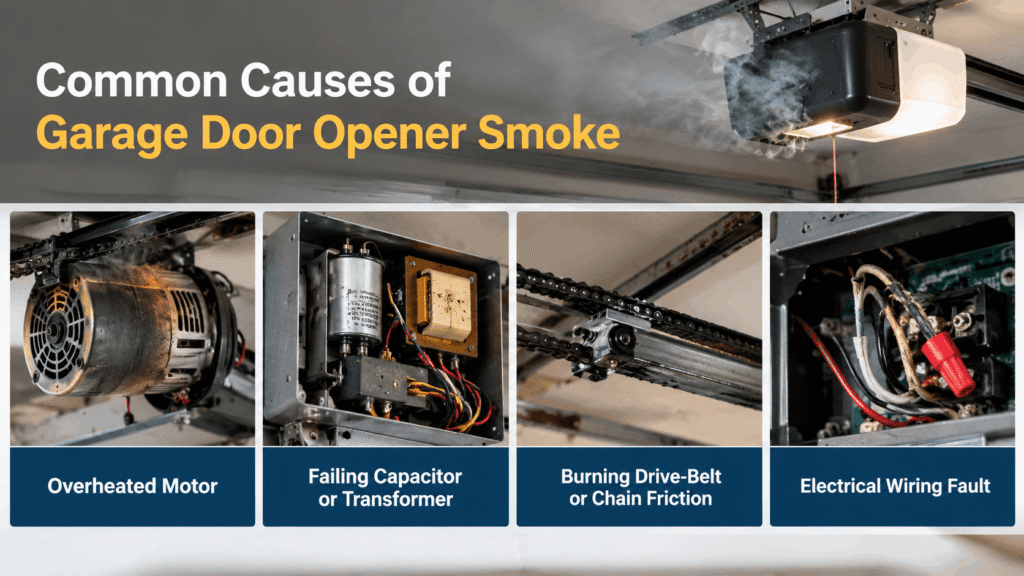
Overheated Motor
Garage door opener motors are built for intermittent use — a few cycles a day, not constant running. If the door has been opening and closing repeatedly in a short window, or if something is obstructing the door’s travel and forcing the motor to strain, the motor windings can overheat and start smoking.
Failing Capacitor or Transformer
The capacitor gives the motor its starting torque, and the transformer steps down household voltage for the opener’s control board. When either one starts failing, it can overheat and smoke well before the motor itself is damaged. This is one of the more common electrical failure points in openers past the 8–10 year mark.
Burning Drive-Belt or Chain Friction
If the drive belt or chain is too loose, too tight, or misaligned, it can drag against the rail housing. That friction generates heat and produces a burning-rubber smell and light smoke — mechanically different from an electrical fault, but still worth stopping for. If your opener uses a chain, our guide on a loose garage door opener chain covers how misalignment develops and how to fix it.
Electrical Wiring Fault
Frayed or pinched wiring inside the unit, often from age or rodent damage, can short and smoke. This is the least common cause but the most dangerous, since it can smoke even when the opener isn’t actively running a cycle. Residential garage door openers are required to meet UL 325, the safety standard that governs fire and shock hazards for door and gate operators — a wiring fault means the unit is no longer operating within the protections that standard is built around.
Smoke or Smell — What Type Are You Seeing or Smelling?
The exact smell tells you how serious the problem is. Use this table to get a first read before you call anyone.
| Smoke/Smell Type | Likely Cause | Urgency | Next Step |
|---|---|---|---|
| Sharp, electrical/burning-plastic smell | Wiring fault, capacitor failure | Stop immediately | Unplug at outlet, don’t restart |
| Rubber or friction smell | Drive belt/chain rubbing | Monitor closely | Unplug, inspect alignment before reuse |
| Musty, dusty burning smell (no smoke after a few seconds) | Dust burn-off on first seasonal use | Normal, low risk | Run once more to confirm it clears |
| Visible smoke, no strong smell | Motor overheating from overuse | Stop immediately | Unplug, let cool 30+ minutes before inspecting |
Save or screenshot this diagnostic table — it covers the four most common smoke and smell scenarios so you can identify yours in seconds next time. If your issue turns out to be smell without visible smoke, our dedicated guide on a garage door opener burning smell goes deeper into smell-specific causes.
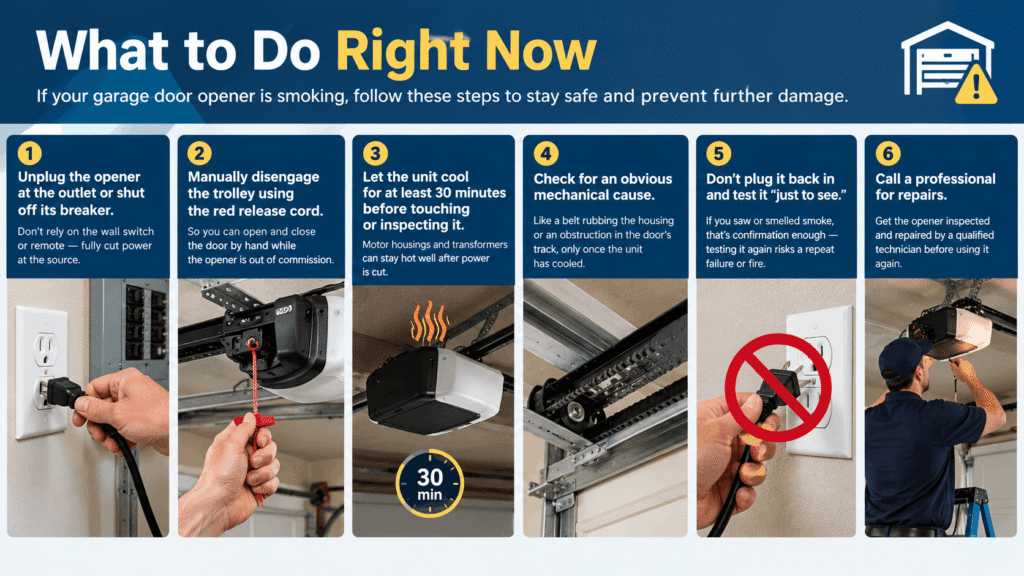
What to Do Right Now
- Unplug the opener at the outlet or shut off its breaker. Don’t rely on the wall switch or remote — fully cut power at the source.
- Manually disengage the trolley using the red release cord so you can open and close the door by hand while the opener is out of commission.
- Let the unit cool for at least 30 minutes before touching or inspecting it — motor housings and transformers can stay hot well after power is cut.
- Check for an obvious mechanical cause, like a belt rubbing the housing or an obstruction in the door’s track, only once the unit has cooled.
- Don’t plug it back in and test it “just to see.” If you saw or smelled smoke, that’s confirmation enough — testing it again risks a repeat failure or fire.
Will Unplugging the Opener Reset It?
Unplugging a garage door opener does reset its logic board and clears any temporary electrical fault, similar to restarting a computer. But unplugging it does not fix a mechanical or hardware failure — if the smoke was caused by a failing capacitor, worn belt, or damaged wiring, the problem will return as soon as you plug it back in and run a cycle.
Can a Garage Door Opener Overheat Without Smoking?
Yes. Overheating often shows up first as the motor running noticeably louder, the opener stalling mid-cycle, or the unit feeling hot to the touch, all before any visible smoke appears. If you notice these signs, treat them the same as smoke — stop use and let the unit cool rather than waiting for it to progress further.
How Long Should a Garage Door Opener Last?
Most garage door openers last 10 to 15 years with normal use. Smoking is far more common in units past that age range, since motor windings, capacitors, and transformers all degrade over time. If your opener is within that window and starts smoking, it’s reasonable to weigh repair cost against simply replacing the unit.
When to Call a Professional vs. DIY
Bold claim: Electrical smoke from a garage door opener is not a safe DIY repair — the risk of shock or fire from working inside a live control board outweighs the cost of a service call.
DIY is reasonable only for the dust-burn-off scenario in the table above, where the smell clears after one cycle and doesn’t return. For anything involving a persistent electrical or burning smell, a motor that’s hot to the touch, or smoke that returns after a reset, call a licensed garage door technician. They can test the capacitor and transformer with the right equipment and replace the unit safely if it’s beyond repair.
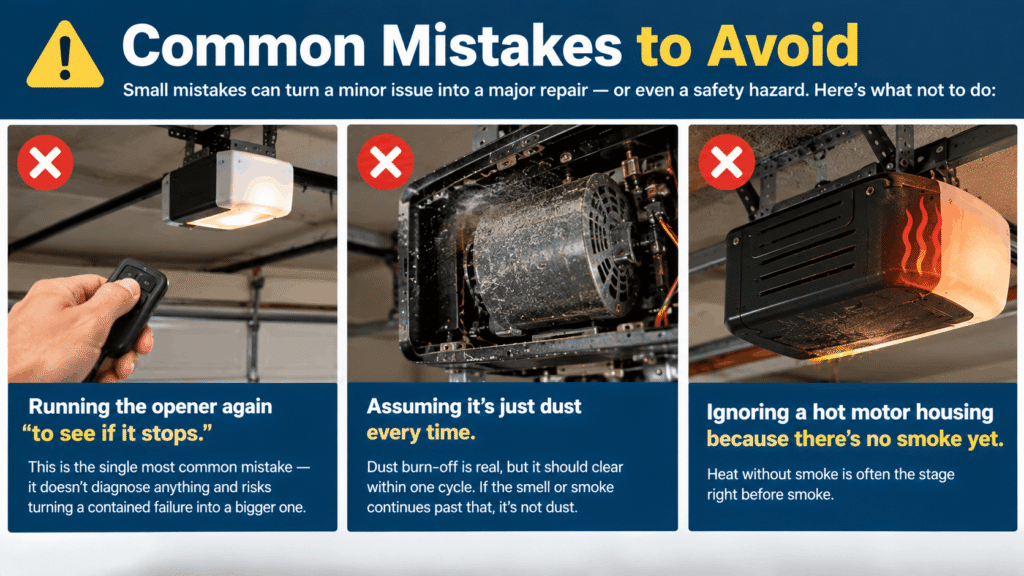
Common Mistakes to Avoid
- Running the opener again “to see if it stops.” This is the single most common mistake — it doesn’t diagnose anything and risks turning a contained failure into a bigger one.
- Assuming it’s just dust every time. Dust burn-off is real, but it should clear within one cycle. If the smell or smoke continues past that, it’s not dust.
- Ignoring a hot motor housing because there’s no smoke yet. Heat without smoke is often the stage right before smoke.
FAQs
What could be causing smoke to come out of my garage door opener?
Smoke usually comes from an overheating motor, a failing capacitor or transformer, or a drive belt rubbing against the housing from misalignment. Less commonly, it’s a wiring fault inside the unit. The smell — electrical, rubber, or dusty — is the fastest way to narrow down which one you’re dealing with.
Can a garage door opener overheat?
Yes, garage door opener motors are built for intermittent use, and repeated cycling, an obstructed door, or an aging capacitor can all cause the motor to run hotter than it’s designed for. Overheating often shows up as noise, stalling, or heat before it ever produces visible smoke.
What is the average life expectancy of a garage door opener?
Most garage door openers last 10 to 15 years under normal use. Components like capacitors and transformers tend to fail toward the end of that range, which is why smoking issues become more common in older units.
Will unplugging the garage door opener reset it?
Unplugging clears the opener’s control board, resetting any temporary electrical glitch, but it won’t fix a mechanical or hardware problem. If a failing part caused the smoke, the issue will return once the unit is plugged back in and used again.
Is it safe to use my garage door manually if the opener is smoking?
Yes — disengage the trolley using the red release cord, and you can open and close the door by hand while the opener is unplugged and out of service. This keeps you from being locked out of your garage while you sort out the repair.
What to Do Next
If the smoke smell is tied to a burning odor rather than smoke itself, our guide on garage door opener burning smell breaks down the smell-specific causes in more depth. Once your opener is unplugged and out of service, you’ll likely need to know how to work around a door that won’t open or close normally until it’s repaired. And if you want the full picture of how the motor, capacitor, and drive system work together, how a garage door opener works is a good next read.