
Your garage door just opened on its own, or reversed halfway down, or the remote worked yesterday and does nothing today—and now you’re staring at the box on your ceiling, wondering what’s actually happening inside it. Here’s the full mechanical breakdown, in plain terms, so you know exactly what’s normal and what’s not.
Quick Answer: A garage door opener is a motorized drive system. Pressing the remote sends a wireless rolling-code signal to a receiver, which engages a motor connected to a trolley on an overhead rail. The trolley pulls the door open or closed using a chain, belt, or screw drive, while two photo-eye sensors near the floor continuously check for obstructions and reverse the door if anything breaks the beam.
Table of Contents
What You Need to Know
- The opener has five core parts: motor unit, drive mechanism, trolley, safety sensors, and remote/wall control.
- Since 1993, U.S. law under UL 325 has required auto-reverse safety sensors on all residential garage door openers.
- Chain drives are the loudest and cheapest; belt drives are the quietest; screw drives sit in the middle on both counts.
- Openers “know” where to stop using adjustable travel limits, not guesswork.
- Every opener has a manual release cord for operating the door by hand during a power outage.
How a Garage Door Opener Works, Step by Step
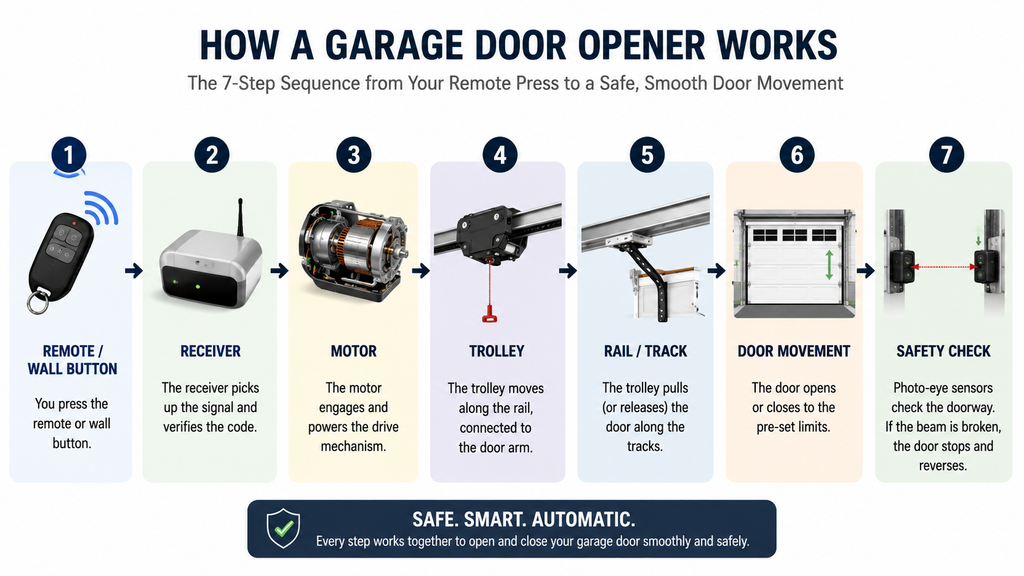
A garage door opener converts a wireless button press into controlled mechanical movement, using a motor, a drive system, and a pair of safety sensors that monitor the doorway the entire time the door is moving.
Here’s the sequence, start to finish:
- You press the remote or wall button. This sends a radio-frequency signal using rolling-code encryption, meaning the code changes every time so old signals can’t be reused to open the door.
- The receiver inside the motor unit picks up the signal. It checks the code against the last one it received and, if valid, activates the motor.
- The motor engages the drive mechanism. Depending on your opener, this is a chain, a rubber belt, or a threaded steel screw running the length of an overhead rail.
- The trolley moves along the rail. The trolley is the part physically connected to the drive mechanism, and it’s attached by an arm to the top of the garage door itself.
- The door travels along its tracks. As the trolley moves, it pulls (or releases) the door along the vertical and curved tracks mounted to your garage walls and ceiling.
- The photo-eye sensors monitor the doorway. Two small sensors, mounted about 4–6 inches off the floor on either side of the door, send an invisible infrared beam across the opening. If anything breaks that beam while the door is closing, the door stops and reverses immediately.
- The opener stops at a pre-set limit. Built-in travel limit settings tell the motor exactly how far to run before cutting power, so the door doesn’t slam into the floor or the header.
The Core Components of a Garage Door Opener
Save or screenshot this component breakdown — it covers every part you’d need to identify for a repair call or a manual.
Component Function: Motor unit Houses the motor, receiver, and control board; the “brain” of the system Drive mechanism (chain, belt, or screw) Transfers motor power into linear motion along the railTrolley Connects the drive mechanism to the door via a curved arm rail The metal track the trolley rides along, mounted to the ceiling Photo-eye sensors Two infrared sensors that detect obstructions and trigger auto-reverse Wall control: Hardwired button inside the garage for manual open/close and light control Remote control / keypad Wireless trigger using rolling-code radio frequency Manual release cord Red cord that disconnects the trolley from the drive system for manual operation
Which Drive Mechanism Do You Have — Chain, Belt, or Screw?
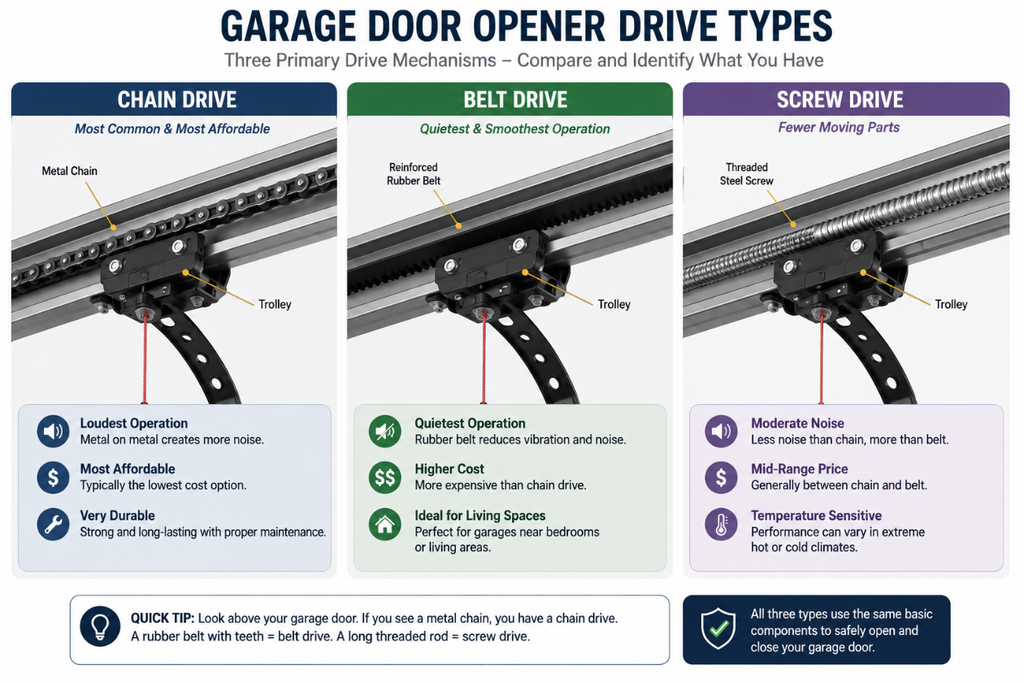
The drive mechanism is the single biggest factor in how loud and how expensive your opener is, and it’s worth understanding before you compare full unit options.
- Chain drive: A metal chain pulls the trolley, similar to a bicycle chain. It’s the most affordable option but also the loudest, since metal-on-metal contact vibrates through the rail into the ceiling.
- Belt drive: A reinforced rubber belt replaces the chain. It runs significantly quieter, which matters most if your garage sits under or beside a bedroom.
- Screw drive: A threaded steel rod turns to move the trolley. Fewer moving parts than a chain, moderate noise level, but performance can be more temperature-sensitive in extreme climates.
- Direct drive: The motor itself moves along a stationary chain, rather than the chain moving a fixed motor. This is the newest and quietest configuration.
For a full side-by-side comparison of these four types, including which fits which garage setup, see Types of Garage Door Openers: A Complete Comparison.
How Does the Remote Signal Work?
Your garage door remote doesn’t send the same code every time you press it, which is exactly why it’s difficult to intercept or clone.
Modern openers use rolling code technology: each button press generates a new code from a shared algorithm known only to the remote and the receiver. If someone recorded yesterday’s signal, it simply won’t work today. This is a meaningful upgrade over older fixed-code openers manufactured before the mid-1990s, some of which are still in use and are genuinely vulnerable to code-grabbing devices.
How Does the Safety Reversal System Work?
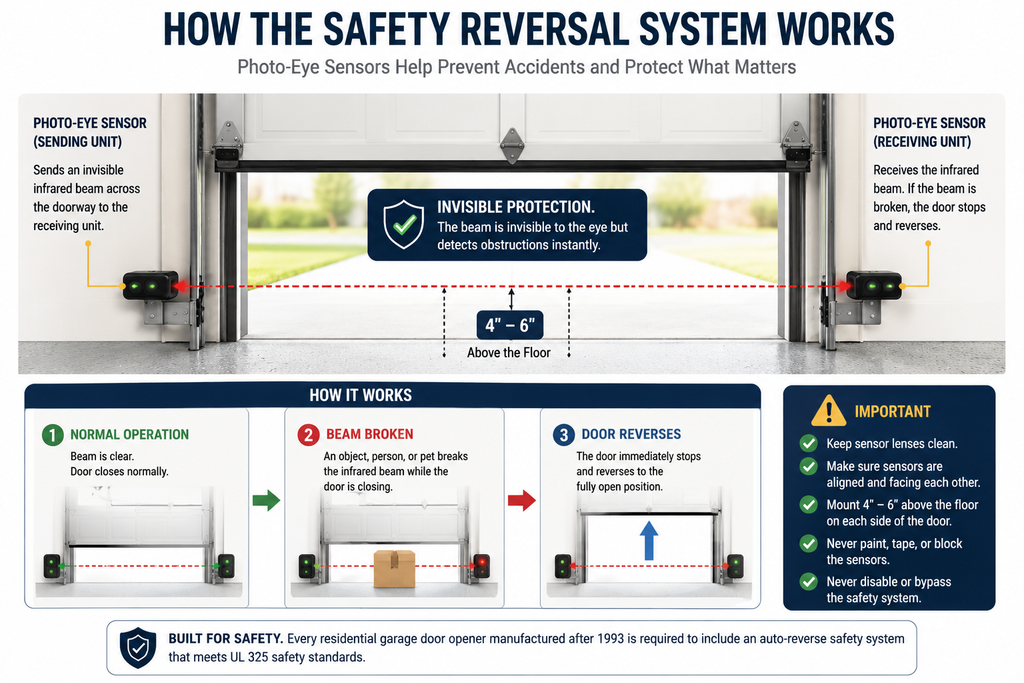
If your door has ever opened or reversed with no one near the remote, it’s almost never “possessed”—it”‘s the safety system doing exactly what it’s designed to do, or a sensor malfunction pretending to be an obstruction.
Every residential garage door opener manufactured after 1993 is required under UL 325 to include an auto-reverse safety mechanism, typically photo-eye sensors mounted low on either side of the door frame. These sensors project an infrared beam across the doorway. If that beam is broken by a person, pet, or object while the door is closing, the door immediately stops and reverses to the fully open position — this is the single most important safety feature on the entire unit.
A door that reverses for no visible reason is usually one of these:
- Sensors misaligned (even slightly) so the beam doesn’t connect
- A sensor lens dirty or covered in cobwebs
- Direct sunlight hitting one sensor and confusing the reading
None of these are user-serviceable safety fixes to bypass, realign, or clean the sensors, but never disconnect them.
How Does the Opener Know When to Stop?
The motor doesn’t “feel” the door reach the floor—it relies on two separate settings that have to be programmed correctly during installation.
- Travel limits tell the opener the exact distance the door should travel before stopping—one limit for fully open and one for fully closed.
- Force settings tell the motor how much resistance is acceptable before it assumes it’s hit an obstruction and reverses, protecting both the door and anything in its path.
If a door stops short of the floor, reverses immediately after touching down, or struggles to fully open, incorrect travel or force limits are the most common cause — not a broken motor.
What Happens During a Power Outage?
Every garage door opener includes a manual release cord — usually a red rope hanging from the trolley — that disconnects the trolley from the drive mechanism entirely. Pulling it lets you lift and lower the door by hand, exactly like a door with no opener installed at all. Reconnecting it after power returns is as simple as pulling the cord toward the motor unit until the trolley locks back into the rail.
Common Mistakes People Make With Garage Door Openers
- Ignoring dirty or misaligned sensors instead of realigning them, which leads to random reversals that look like a bigger problem than they are.
- Disconnecting or taping over safety sensors to “fix” a reversal issue — this defeats the entire safety system and is genuinely dangerous.
- Assuming a slow-closing door means a dying motor when it’s often just a force-setting adjustment.
- Never testing the auto-reverse function, even though manufacturers recommend testing it monthly by placing an object in the door’s path.
How Long Do Garage Door Openers Last?
Most residential garage door openers last 10 to 15 years with normal use, though the drive mechanism (chain, belt, or screw) sometimes needs replacement before the motor itself fails. If your opener is straining, making new noises, or the logic board is no longer receiving remote signals reliably even after replacing batteries, that’s a sign of age rather than a quick fix. If your door reverses unpredictably, won’t reverse at all, or a sensor light won’t hold steady, don’t attempt to bypass the safety sensors yourself—that’s a job for a licensed technician, since a faulty auto-reverse system is a genuine safety hazard, not just an inconvenience.
FAQ
How do garage door openers get power?
Garage door openers plug into a standard 120V household outlet, typically mounted near the motor unit on the garage ceiling. A dedicated circuit is recommended but not always required. Battery backup units are available as an add-on for openers that need to function during outages.
How do garage door openers know when to stop?
They rely on programmed travel limits that define the fully open and fully closed positions, plus force settings that detect resistance. If the door pushes back too hard against an object, the motor treats it as an obstruction and reverses rather than continuing to close.
How do I operate a garage door opener?
Press the wall-mounted control or the wireless remote to trigger opening or closing. The photo-eye sensors will automatically stop and reverse the door if anything breaks the beam while it’s closing, so it’s safe to walk through as it’s operating—though it shouldn’t be treated as routine.
How does a garage door open by itself?
This is almost always one of three things: a stuck remote button transmitting a signal, interference from a nearby frequency, or in rare cases a failing logic board sending false signals. It is not caused by the safety sensors, which only stop or reverse a door — they don’t trigger it to open.
What’s the difference between chain-drive, belt-drive, and screw-drive openers?
Chain drives use a metal chain and are the loudest but most affordable. Belt drives use a reinforced rubber belt and run the quietest. Screw drives use a threaded rod and sit in the middle for both noise and cost, with some sensitivity to extreme temperatures.
What to Do Next
Now that you know how the mechanism works, the next logical step depends on what brought you here:
- Curious which type fits your garage? See Types of Garage Door Openers: A Complete Comparison for a full breakdown of chain, belt, screw, and direct-drive options.
- Want the foundational overview first? Start with What Is a Garage Door Opener? How It Works, Safety Features & Expert Tips.
- Dealing with an unusual noise or reversal issue? (Content gap — no troubleshooting article exists yet on AccessifyHome.com. This is the highest-priority next article given PAA search demand around unexpected reversals and stopping behavior.)