
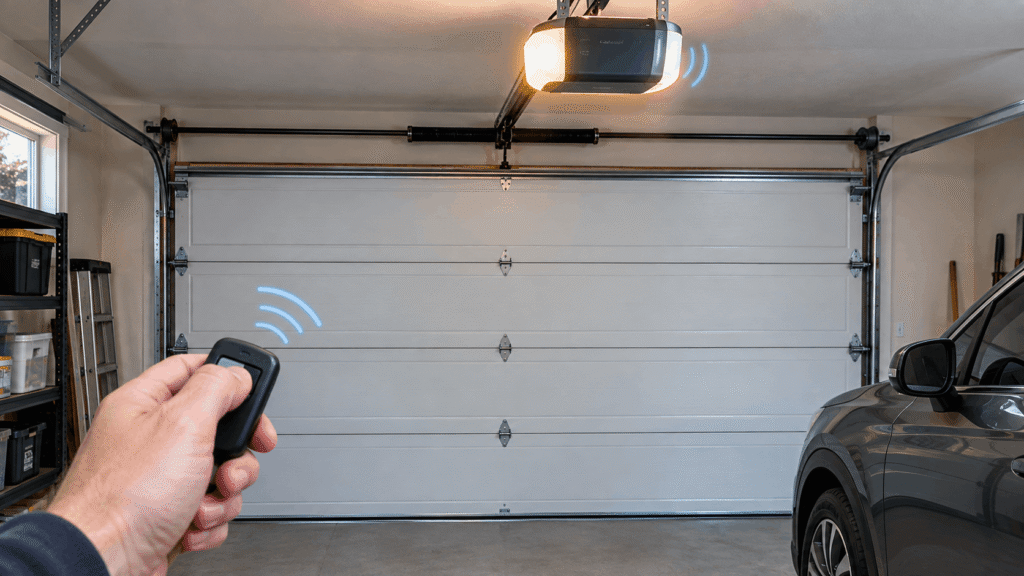
You hit the button, the motor hums, and the door stays exactly where it is. It’s a stressful moment, especially if your car is inside, but this fault is usually simple to diagnose in about two minutes.
Quick Answer: When a garage door opener runs but the door won’t move, the cause is usually a disconnected trolley, a stripped drive gear, or a broken spring. In two minutes, pull the release cord and lift the door by hand. If it moves easily, the opener is at fault; if it feels very heavy, stop and call a technician.
Table of Contents
What You Need to Know
- A running motor means the motor itself is probably fine. The failure is between the motor and the door.
- The three most common causes are a disconnected trolley, a stripped drive gear or slipping chain, and a broken spring.
- The hand-lift test tells you which side of the system failed.
- Springs and cables are professional-only repairs. The other fixes are often DIY.
- The fix table below covers every sound and symptom in this article.
Why Does My Garage Door Opener Run But the Door Won’t Move?
A garage door opener that runs without moving the door has lost the mechanical link between the motor and the door, or the door is too heavy for the opener to lift. The most likely causes, in order, are a disconnected trolley, a stripped drive gear or slack chain, and a broken spring. The motor running is good news: it rules out the most expensive part.
Here is the counterintuitive part. Your opener doesn’t lift the door on its own. The springs do the heavy lifting, and the opener mostly guides the door along the track. That is why a broken spring can make a perfectly healthy opener look dead.
What Should I Check First? (2-Minute Quick Checks)
Start with the cheapest checks: power, remote, and the release handle. Most of these take under two minutes and need no tools.
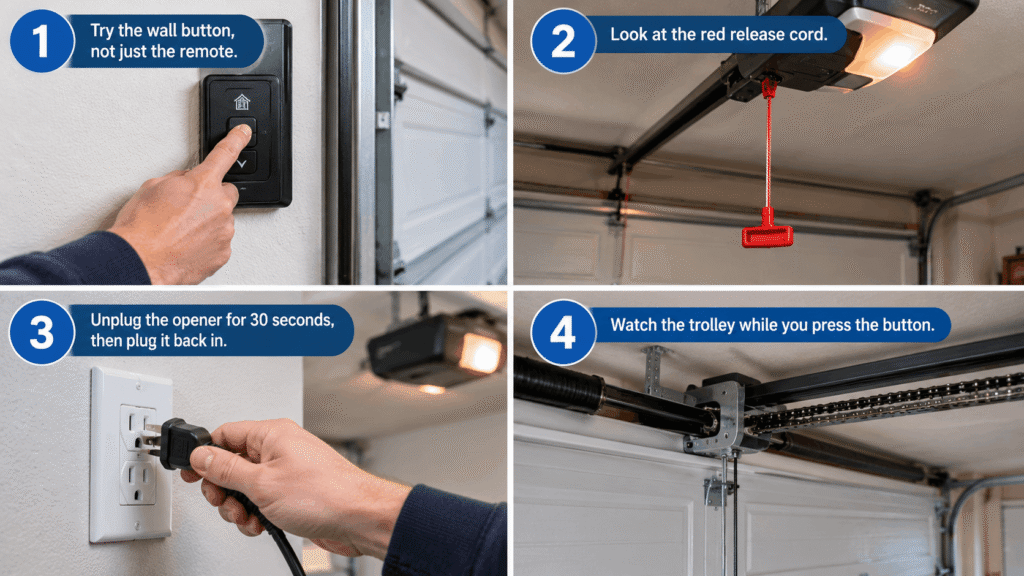
- Try the wall button, not just the remote. If the wall button works, the fault is the remote or its battery, not the opener.
- Look at the red release cord. If the handle is hanging down or the trolley sits apart from the carriage, the door is disconnected. Skip to the next section.
- Unplug the opener for 30 seconds, then plug it back in. This clears logic-board glitches but won’t fix a mechanical fault. See the FAQ for what it does and doesn’t reset.
- Watch the trolley while you press the button. If the trolley slides along the rail but the door doesn’t move, the link to the door is broken. If nothing on the rail moves, suspect the gear or chain.
If the opener stopped after a storm or outage, our guide on garage door openers not working after a power outage covers the reset steps.
Is the Door Disconnected from the Opener?
A disconnected trolley is the most common and easiest cause. The red release cord separates the door from the opener so you can lift it by hand, and a bump, a pull, or a kid’s curiosity can trip it.
Reconnect it like this:
- Close the door completely. Never work on the release with the door open and unsupported.
- Pull the red cord toward the opener (or follow your model’s diagram) so the trolley arm can latch.
- Run the opener once with the wall button. On many models, the carriage re-engages the trolley as it travels down the rail.
- Confirm the latch. Try lifting the door by hand. It should now resist and follow the opener.
The exact reconnect motion varies by brand, so check your manual for the diagram. The most common mistake reported in owner forums is pulling the cord the wrong direction and assuming the trolley is broken.
Is the Drive Gear or Chain Stripped?
A stripped drive gear or slipping chain lets the motor spin without pulling the trolley. Many openers use a nylon or plastic gear that wears down over years, and chain and belt drives can stretch or slip.
Look for these signs:
- A grinding or whirring sound while nothing on the rail moves
- Plastic or metal shavings inside the motor housing
- A slack chain or belt, or one that has come off the sprocket
A drive gear is a small gear inside the opener that transfers motor power to the chain or belt. Replacement kits exist for many models. Unplug the opener before opening the housing. If the problem shows up in both directions, our guide to garage door opener problems with opening and closing helps you compare symptoms.
Could a Broken Spring Be the Real Problem?
If the door feels very heavy when lifted by hand, the problem is the spring, not the opener. Springs counterbalance the door’s weight, so when one breaks, an opener that can’t lift the full weight will hum, strain, or lift the door only a few inches.
Signs of a broken spring:
- A loud bang from the garage earlier, often mistaken for something else
- A visible gap in the coiled torsion spring above the door
- A door that feels like dead weight when lifted by hand to waist height, or one that drops instead of staying put
- Crooked, sagging, or loose cables on one side
Do not touch the spring, the winding cones, or the cable brackets. The Door & Access Systems Manufacturers Association (DASMA) calls springs arguably the most important and most dangerous part of a garage door, says frayed cables should be replaced only by a trained technician, and advises replacing both springs on a two-spring door even if only one has broken. Read the full list in DASMA’s garage door safety tips{target=”_blank”}. dasma
If the door is stuck partway up or down, our article on a garage door stuck halfway explains what to do while you wait for help.
What If the Opener Clicks But Nothing Moves?
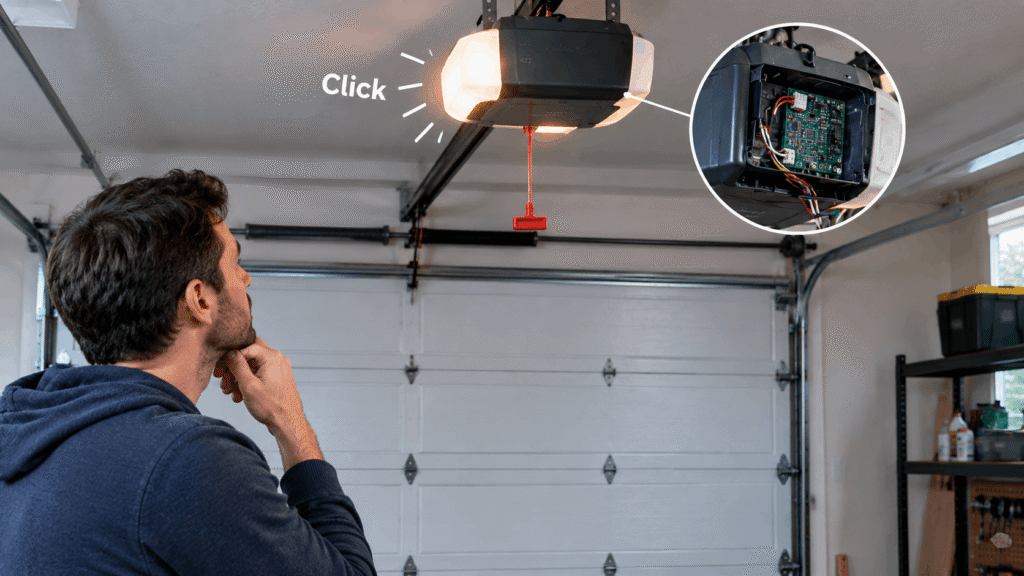
Clicking with no motor sound usually points to the opener’s electronics or a load it can’t move, not a disconnected trolley. This is a different fault from “runs but doesn’t move,” so treat it separately.
Common causes are a failing relay on the logic board, a worn capacitor, or an opener that clicks and stops because the door is too heavy to lift. Try the 30-second unplug reset first. If the click returns and the door is heavy by hand, suspect the spring. If the door moves easily and the click continues, the opener’s electronics need a technician or replacement.
Garage Door Opener Fix Table: Sound, Symptom, Cause, Fix
Match what you hear and what the door does to the likely cause.
| What you hear | What the door does | Likely cause | Fix | DIY? |
|---|---|---|---|---|
| Smooth hum, trolley slides on rail | Door doesn’t move | Trolley disconnected | Reconnect release; run opener | Yes |
| Whirring, trolley barely moves | Door doesn’t move | Stripped drive gear | Replace gear kit | Intermediate |
| Motor runs, chain/belt slack | Door doesn’t move | Slipped or broken chain/belt | Tension or replace | Often |
| Strained hum or short lift | Door heavy by hand | Broken spring | Call a pro | No |
| Single click, no motor | Nothing happens | Relay, capacitor, or logic board | Reset; then technician | No |
| Motor runs, door crooked | One side sags | Cable off drum or track issue | Call a pro | No |
Save or screenshot this garage door troubleshooting table. It covers every symptom in this article, and it works when you’re standing in the garage with no signal.
Want a printable version? Join the Accessify Home newsletter and we’ll send this checklist as a one-page PDF you can keep in the garage.
What Mistakes Make This Problem Worse?
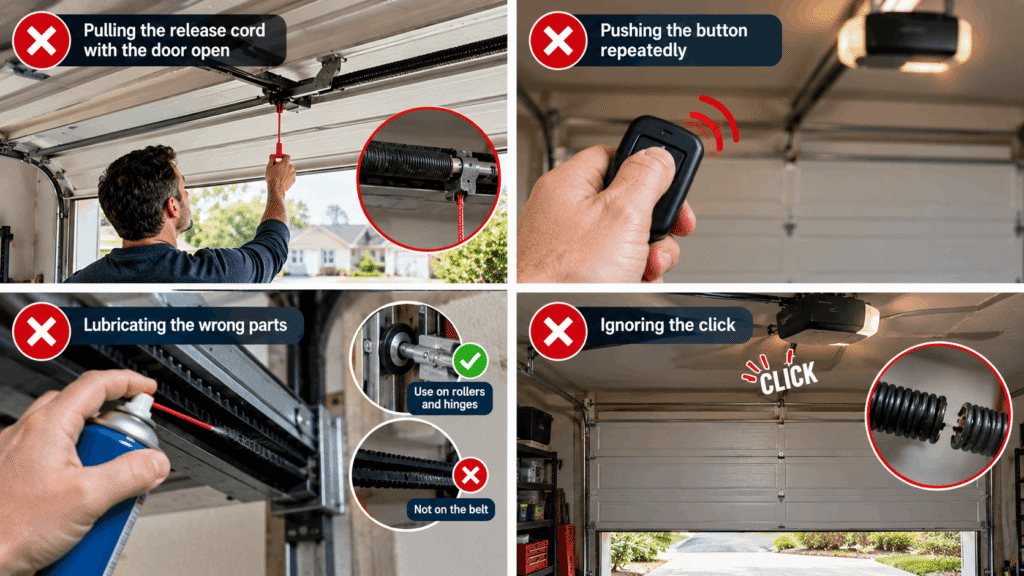
The costliest mistake is forcing the door or the release when a spring may be broken. Owners often assume the opener is dead, then yank the door up or keep pressing the button.
- Pulling the release cord with the door open, which can send a spring-broken door crashing down
- Pushing the button repeatedly, which can strip a gear that was only slipping
- Lubricating the wrong parts. Use garage door lubricant on rollers and hinges, not the belt
- Ignoring the click. A door that was fine yesterday often loses a spring quietly
When Should I Call a Professional Instead?
Call a professional for any spring, cable, or track problem, and for any door that is off its rails. These repairs involve high tension and heavy loads, which is why DASMA recommends professional inspection and replacement of springs{target=”_blank”}.
You can handle the trolley reconnect, a power reset, and often a chain adjustment. A technician can also confirm whether the opener itself is worth repairing. For more repair guides while you decide, browse our garage door repair category.
[CONTENT GAP: a “garage door repair cost” or “find a local technician” page would go here as the next step. Add it as a link once the page exists.]
FAQs
Why is my garage door opener running but the door won’t lift?
The most common causes are a disconnected trolley, a stripped drive gear, or a broken spring. The motor running means the motor is probably healthy. Pull the release cord with the door closed, then lift the door by hand. If it moves easily, the problem is in the opener. If it feels very heavy, it’s the spring.
Why would my garage door opener open the door but not close it?
This is a different fault, usually the safety sensors or the close-force setting. Misaligned sensors, a blocked beam, or a blinking sensor light can make the door reverse or refuse to close. Clean the sensor lenses and check alignment first. If it keeps reversing, our guide on why a garage door goes down halfway then back up explains the settings.
Will unplugging the garage door opener reset it?
Yes, but only the electronics. Unplug it for about 30 seconds, then plug it back in. This clears logic-board glitches and can restore a confused opener. It won’t fix a stripped gear, a disconnected trolley, or a broken spring, so use it as a quick check and move on if nothing changes.
My garage door isn’t moving and just clicks. What could be causing this?
Clicking without a running motor usually means a relay, capacitor, or logic-board fault, or an opener that can’t lift a heavy door. Try a 30-second unplug reset. If the door is heavy by hand, suspect a broken spring. If the door moves easily and the click continues, the opener’s electronics need repair.
Is it safe to use the emergency release when the door won’t move?
Only with the door fully closed. Pulling the release with the door open can drop a door with a broken spring. Keep your hands clear of the springs, cables, and brackets, and never stand under a door you can’t see moving normally. If the door is open and stuck, call a professional.
What to Do Next
- If your door stalls partway, read our guide on a garage door stuck halfway.
- If the opener also struggles in both directions, see garage door opener problems opening and closing.
- Browse more fixes in our garage door repair category.
- [CONTENT GAP: repair-cost or local-technician page, to be linked here once published.]
Pingback: Garage Door Opener Won't Reconnect After a Power Cut?