
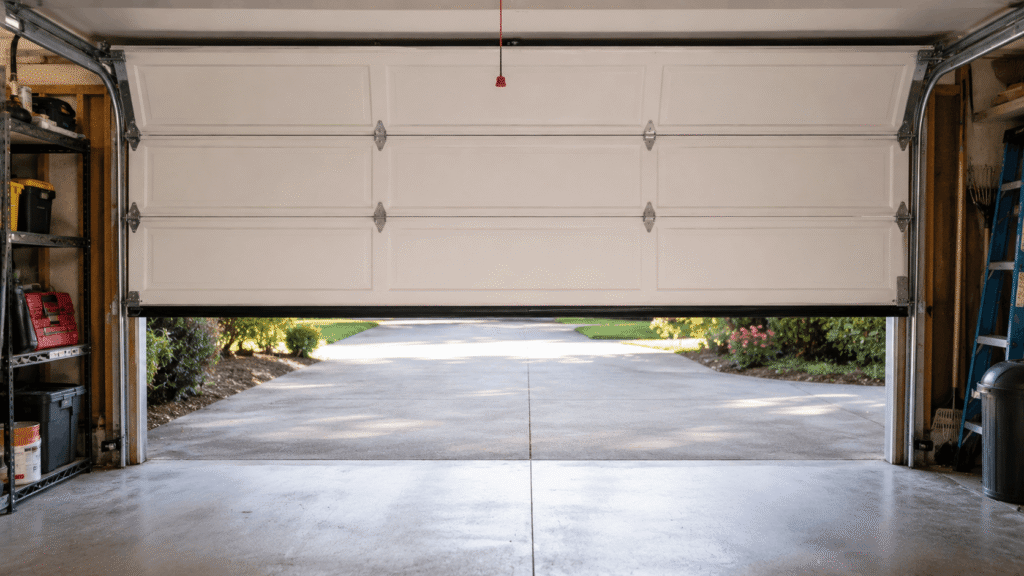
You hit the button, the door starts down, and a few feet in it stops and rolls back open — sometimes with a beep, sometimes silently. It’s late, it’s cold, or you’re already halfway out the driveway. Here’s the good news: this behavior is your opener’s safety system doing exactly what it’s designed to do, and in most cases you can find the exact cause in under ten minutes.
Quick Answer: A garage door that reverses before closing is almost always caused by one of three things: misaligned or blocked safety sensors, a limit switch set to the wrong stop point, or physical resistance in the track or springs. Sensor issues are the single most commonly reported cause, making them the first place to check.
Table of Contents
What You Need to Know
- Sensor problems cause the large majority of reversal issues and take under 5 minutes to check
- Where the door reverses — right at the floor vs. partway down — points to a different cause
- Torsion spring issues can look identical to a sensor problem but are dangerous to DIY
- A door that reverses inconsistently is still a safety feature working correctly, not a sign to force it shut
- Most fixes cost nothing — this is an adjustment problem, not a replacement problem, in the vast majority of cases
Why This Happens
The reversal is the opener’s safety-reverse system detecting an obstruction — real or misread — and stopping the door before it can close on something. According to the U.S. Consumer Product Safety Commission, federal regulations have required entrapment-protection reversing systems on all residential garage door openers manufactured after January 1, 1993 — which is why every opener you’ll find on a store shelf behaves this way.
Four causes account for nearly all reported cases, roughly in order of frequency:
- Safety sensor misalignment or obstruction — the most common cause by a wide margin
- Limit switch set incorrectly — the opener thinks the door should stop before it’s actually shut
- Track or roller resistance — something is physically slowing the door’s descent
- Spring tension imbalance — the door isn’t moving smoothly enough for the opener’s force sensor to accept
Reverses Right at the Floor vs. Reverses Partway Down
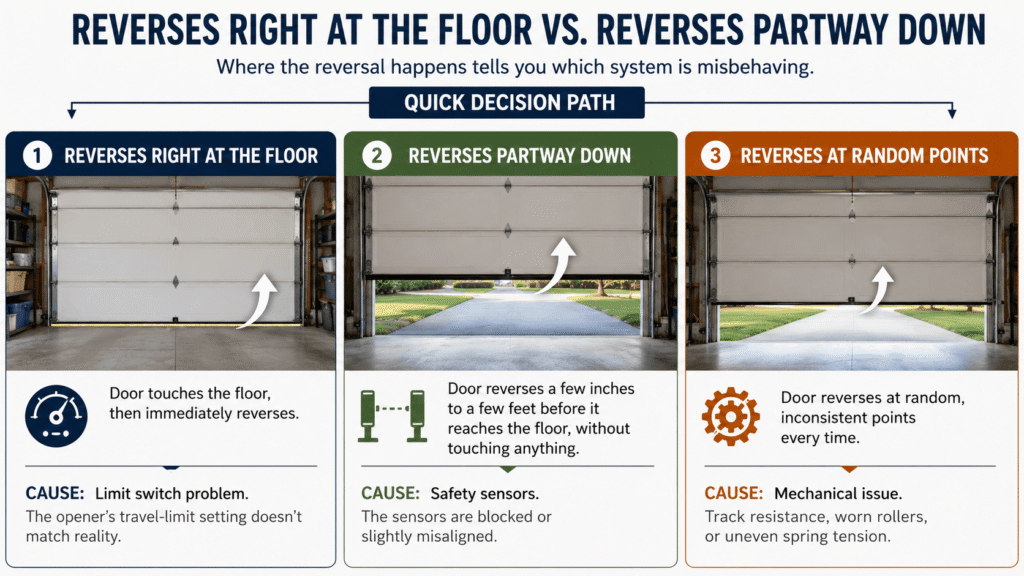
Most guides skip this distinction, but it’s the fastest way to narrow down your cause before you touch anything.
Where the reversal happens tells you which system is misbehaving. Use this quick decision path:
- Door touches the floor, then immediately reverses → this is a limit switch problem. The opener’s travel-limit setting doesn’t match reality, so it reads full contact with the floor as an obstruction.
- Door reverses a few inches to a few feet before it reaches the floor, without touching anything → this is almost always the safety sensors, either blocked or slightly misaligned.
- Door reverses at random, inconsistent points every time → this points to a mechanical issue — a rough spot in the track, worn rollers, or uneven spring tension making the door’s movement irregular enough to trip the force sensor.
Save or screenshot this decision path — it covers the three most common reversal patterns and which fix to try first.
Fix #1: Sensor Misalignment or Obstruction
Check this first — it resolves the majority of cases with no tools required.
Your garage door has two small sensor units mounted near the floor on each side of the track, connected by an invisible infrared beam. If anything breaks that beam, or the sensors aren’t pointed at each other precisely, the door won’t close.
- Locate both sensor units. They should sit no higher than 6 inches off the garage floor on either side of the door track — the maximum height set by the Door & Access Systems Manufacturers Association’s installation standard. If yours are mounted higher, that’s worth correcting on its own.
- Check the LED indicator lights. Most sensors show solid green (or amber) on both units when properly aligned. A blinking or unlit light on either side means misalignment.
- Clear the beam path. Look for cobwebs, dust buildup on the lenses, a stray garden hose, a leaf blower, or a bike leaning against the track — anything crossing between the two units.
- Wipe both lenses with a dry cloth — condensation and dust film block the beam even when nothing is physically in the way.
- Realign if the light is still off. Loosen the wing nut or mounting screw on the sensor bracket and gently pivot the unit left-right and up-down in small increments until the indicator light goes solid. Most sensors have roughly a half-inch of aiming tolerance before the beam misses.
If you’ve followed our garage door opener troubleshooting guide before and reset the opener without checking sensor alignment specifically, this step is worth revisiting — it’s the single most overlooked cause.
Fix #2: Limit Switch Out of Adjustment
If the door reaches the floor and then reverses, the opener’s stop point needs to be reset — not the sensors.
The limit switch tells the motor exactly how far to travel before it should consider the door “closed.” When that setting is off, the opener reads solid floor contact as resistance and reverses to protect against crushing an obstruction.
- Locate the limit adjustment screws or dial on the opener’s motor housing — location varies by brand, but it’s typically two small dials or a digital menu labeled “down limit” or “close limit.”
- Adjust the down-limit setting in small increments — most manufacturers recommend quarter-turns, not full turns, since a small change moves the stop point significantly.
- Run a full test cycle after each adjustment, and re-test the safety-reverse function every time you adjust anything — Chamberlain Group’s official support documentation flags this as a required step after any travel or force limit change, not an optional check.
- Repeat until the door closes flush with the floor without reversing, and reopens smoothly on the next test.
Understanding how the limit switch fits into the opener’s broader logic helps here — our guide on what a garage door opener is and how it works breaks down the motor, sensors, and limit system as one connected unit rather than isolated parts.
Fix #3: Track Resistance or Spring Tension
If reversal happens at random points, the door’s movement isn’t smooth enough for the opener’s force sensor — and that has a mechanical cause, not an electronic one.
- Rollers and track: Inspect the metal track for dents, debris, or a section where the door visibly hesitates. Worn nylon rollers often show cracking or flat spots and create uneven resistance the opener misreads as an obstruction.
- Spring tension: Garage doors run on torsion or extension springs that counterbalance most of the door’s weight — often 150 to over 300 pounds — so the opener motor only handles a small fraction of that load. When a spring loses tension, the opener has to work harder and can trigger the force-sensitivity reversal.
Torsion springs store enough energy to cause serious injury and are not a DIY adjustment — the same federal entrapment-protection standard covering sensors exists because garage doors are, as regulators note, the largest moving object in most homes, and springs under tension are a well-documented cause of the injuries that standard was written to prevent. If you suspect a spring issue, this is the one item on this list to hand off to a professional.
Common Mistakes to Avoid
- Forcing the door shut manually while it’s reversing — this can strip the trolley connection or damage the motor gearing, turning a $0 fix into a repair bill
- Adjusting the limit switch before checking sensors — most people jump straight to the limit dial and end up fighting two problems that were originally just one
- Cleaning only one sensor lens — dust builds evenly on both units, but people often check the sensor closest to the door opener and skip the far one
- Ignoring a door that reverses only occasionally — intermittent reversal is usually an early sign of a sensor going bad or a spring losing tension, not something that resolves on its own
Is It Safe to Keep Using a Door That Reverses Like This?
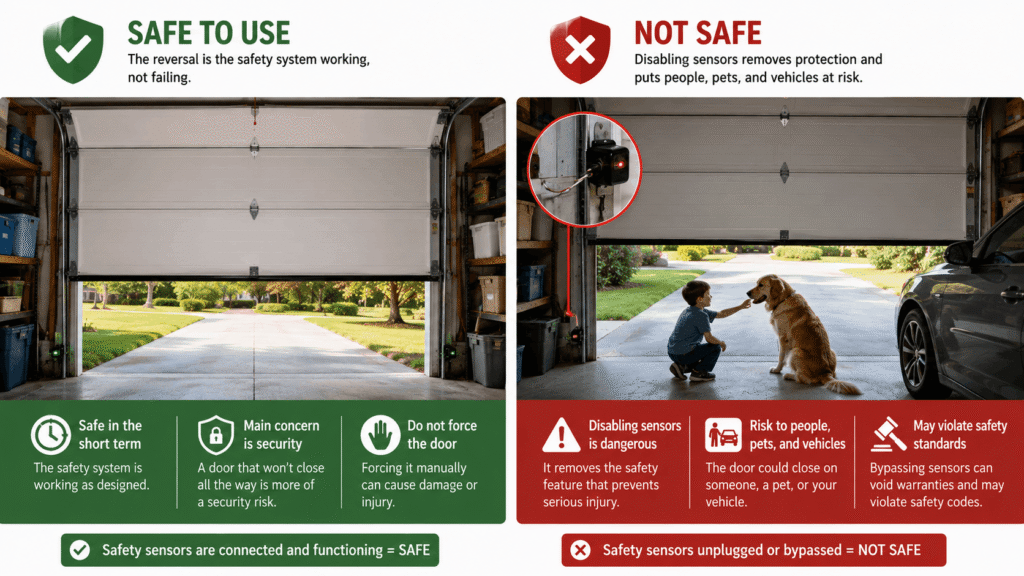
Yes, in the short term — the reversal itself is the safety system working, not failing. A door that won’t close all the way is more of a security concern (an open garage overnight) than a mechanical danger, as long as you’re not forcing it manually or bypassing the sensors to make it close.
That said, don’t disable the safety sensors as a workaround. Unplugging them to force the door shut removes the exact feature that prevents the door from closing on a person, pet, or vehicle.
When to Call a Professional
Call a licensed garage door technician if the door reverses inconsistently after you’ve checked sensors and the limit switch, if you notice a visibly bent track or sagging spring, or if the door feels heavier or lighter to lift by hand than it used to — that’s a spring tension issue outside safe DIY territory.
[CONTENT GAP: no repair-service or replacement-parts commercial page currently exists on AccessifyHome.com — this section is the natural future bridge point once one is built.]
FAQs
How do I reset the sensors on my garage door?
Most sensors don’t have a “reset” button — realignment is the fix. Loosen the mounting bracket on each unit, gently adjust the angle until the indicator light goes solid, then retighten. If the light stays off after realignment, check for a loose wire connection at the base of the sensor.
Why is my garage door only going up halfway?
This is a different issue than reversal on closing — it’s usually a limit switch set too low on the “open” side, a weak or misaligned opener chain/belt tension, or the opener’s motor struggling against a spring that’s lost tension. Check the up-limit setting first.
Why does my garage door fully close and then keep reopening?
This is the same core issue covered above — it typically means either the limit switch stop point is wrong (reversing right at the floor) or a sensor is being intermittently blocked (reversing before touching down). Use the decision path in this guide to tell which one applies to you.
Why does my garage door reverse when it hits the ground?
This specific pattern — contact with the floor followed by immediate reversal — almost always means the down-limit switch is set to expect resistance sooner than the actual floor contact point. Adjusting the limit switch in small increments, as outlined in Fix #2, typically resolves it.
Does cold weather cause garage doors to reverse more often?
Yes — cold temperatures can stiffen lubricant on rollers and tracks, slightly slow the door’s descent, and cause the opener’s force sensor to misread that slowdown as an obstruction. Lubricating the track and rollers with a silicone-based product before winter reduces this.
What to Do Next
Start with the sensors — it’s the fastest check and resolves most cases. If you’re still troubleshooting after that, our full garage door opener troubleshooting guide covers related issues like remote failures and unresponsive keypads. And if you want to understand exactly how the limit switch, sensors, and motor work together before you start adjusting anything, what a garage door opener is and how it works is the background piece worth reading first. If the resistance turns out to be mechanical rather than electronic, our belt drive vs. chain drive comparison explains how drive type affects how smoothly the door travels, which ties directly into the Fix #3 diagnosis above.