
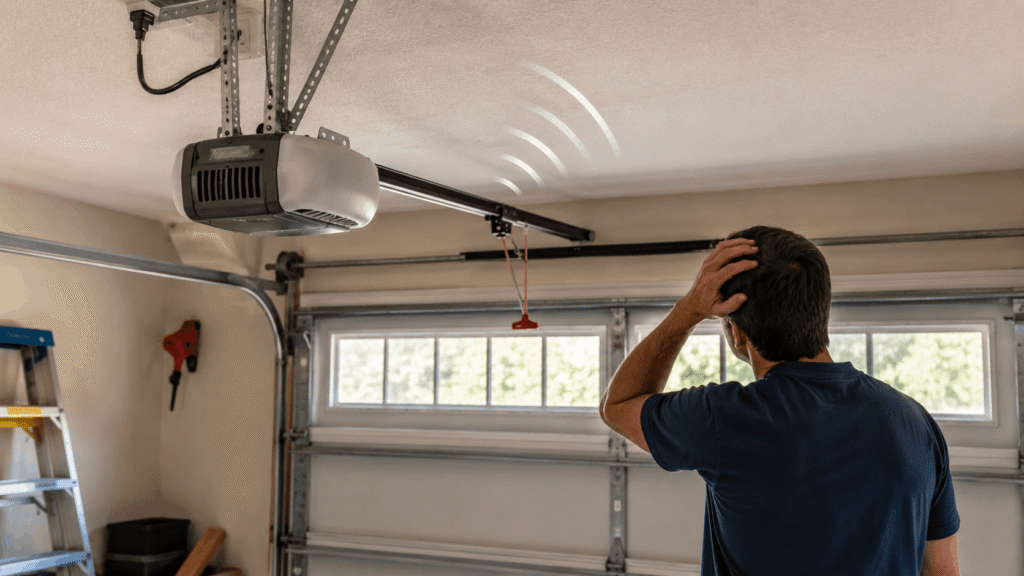
You press the button. The motor hums, clicks, or grinds — and the door doesn’t budge. That’s not a mystery noise. It’s a specific mechanical signal, and once you know what to listen for, you can usually pinpoint the cause in under five minutes.
Quick Answer: A garage door opener that makes noise but doesn’t move usually means the motor is running but the power isn’t reaching the door — most often because the trolley is disconnected (manual release pulled), the drive belt or chain is broken, the drive gear is stripped, or the capacitor is failing. Match the sound to the cause below, then apply the fix.
Table of Contents
What You Need to Know:
- A hum with no movement almost always points to the trolley, capacitor, or motor — not the door itself
- A clicking or grinding sound usually means a stripped gear or a worn belt/chain, not an electrical fault
- The manual release cord is the single most common cause and the easiest fix — check it first
- Blocked photo-eye sensors will stop the door from moving even when the motor sounds fine
- Most causes below are safe DIY checks; only capacitor and spring-adjacent repairs call for a professional
Is It the Opener or the Door?
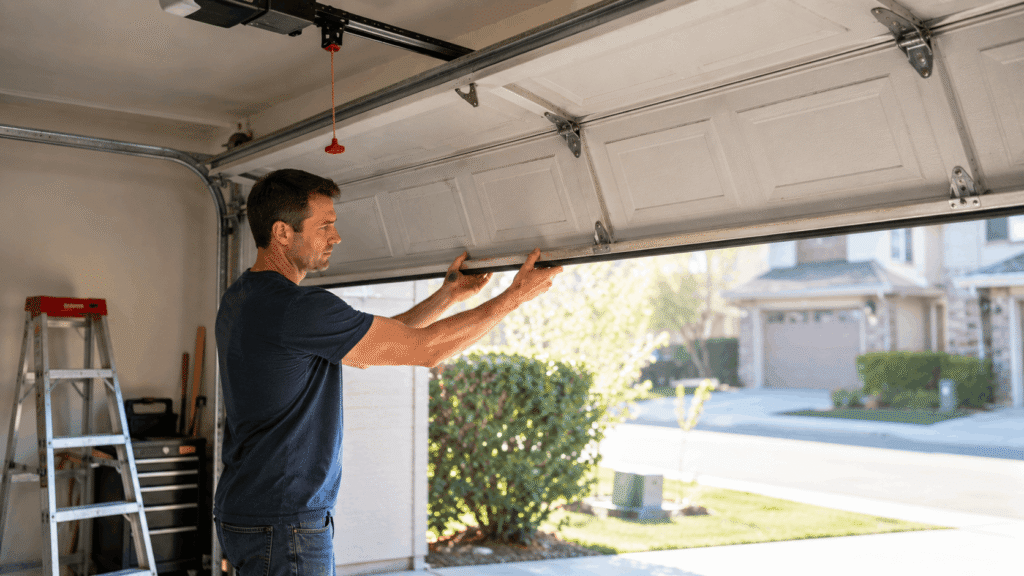
Before diagnosing the opener, rule out the door itself. Grab the manual release handle (usually a red cord hanging from the trolley) and try lifting the door by hand.
If the door is heavy, stuck, or won’t stay open on its own, the problem is the door’s balance — springs, cables, or tracks — not the opener. That’s a separate repair and, if springs are involved, not a DIY job. If the door lifts smoothly and stays open, the opener itself is the problem, and the causes below apply.
If you land here often for opener issues beyond this one, our garage door opener troubleshooting guide is the broader reference this article branches off of.
Cause 1: Trolley Disconnected from Manual Release
This is the most common cause of a humming, non-moving opener, and it takes 30 seconds to fix. Every garage door opener has a manual release mechanism — a cord or lever that disconnects the trolley from the drive rail so you can open the door by hand during a power outage.
If that cord gets bumped, snagged, or pulled accidentally (kids, tall vehicles, stored items brushing against it), the trolley disengages. The motor still runs and still makes noise, but it’s not physically connected to the door anymore.
Fix it:
- Locate the release cord — it hangs from the trolley on the rail, usually with a red handle.
- Pull it toward the motor unit (not down) until you hear or feel it re-engage — most systems click into place.
- Test with the wall button, not the remote, so you can watch the trolley move along the rail.
If it re-engages and the door opens normally, you’re done. If the trolley won’t stay engaged, the release mechanism itself may be worn — that’s a $20–$40 part replacement, not a full opener swap.
Cause 2: Failing Capacitor or Seized Motor
A steady hum with zero movement, especially right after the motor first turns on, points to the capacitor — the part that gives the motor its initial torque to start moving. As openers age (typically 8–15 years in), the capacitor weakens and can no longer supply that starting push, so the motor spins or hums but can’t overcome the door’s initial resistance.
You can test this without opening the unit: unplug the opener, wait 10 minutes, then plug it back in and try again on a completely empty test (nothing attached to the drive gear if you’re comfortable removing it). If it hums the same way every time with no variation, capacitor failure is the leading suspect. Confirming the exact capacitor rating requires checking your model’s nameplate, since it varies by motor size — don’t guess at a replacement part number.
Motor seizure is the other possibility here, especially if the hum has a slightly different pitch than normal or the housing feels hot to the touch after a few seconds. This is not a DIY repair — a seized motor bearing requires disassembly.
Whether this points to a repair or a replacement often comes down to which motor type you have — our garage door opener motor types guide covers how AC and DC motors differ in capacitor reliance and typical failure patterns.
Garage door opener motors and electrical components should only be serviced by someone familiar with the unit’s wiring, given the shock and entrapment risks involved.
Cause 3: Stripped Drive Gear or Worn Belt/Chain
A clicking or grinding sound — not a smooth hum — almost always means the connection between the motor and the drive mechanism has physically failed. Most openers use a plastic drive gear that intentionally wears out before the metal motor housing does; it’s a sacrificial part by design.
- Chain-drive openers: listen for a rhythmic clank or slack-chain rattle. A loose or broken chain won’t pull the trolley even while the motor runs fine.
- Belt-drive openers: listen for a slipping or squealing sound rather than a hard click. A frayed or snapped belt spins the motor with no resistance at all — which is why it can sound almost too quiet.
If you’re not sure which drive type you have or want to weigh a repair against a full swap, our belt drive vs. chain drive comparison breaks down the tradeoffs, including which one tends to strip gears faster.
Fix it: A stripped drive gear is a $15–$30 part and one of the few internal repairs a confident DIYer can handle — it typically involves removing the motor cover and sliding the old gear off the shaft. A broken chain or belt is a full-length replacement, sold to match your rail size.
Cause 4: Blocked Sensors or Track Obstruction
If the motor runs, the drive engages, and you still get nothing, check the photo-eye safety sensors before anything else — the two small sensors mounted a few inches off the floor on either side of the track. If they’re misaligned, dirty, or something is blocking the beam between them, most openers will refuse to move the door at all, sometimes with a rapid blinking light as the only clue.
Wipe both lenses clean and make sure nothing — a stored bike, a box, a shadow from direct sunlight hitting one sensor — sits in the beam path. Also check the track itself for visible obstructions, bent rail sections, or debris the rollers can’t pass.
Per general garage door safety guidance, these sensors exist specifically to prevent the door from closing on a person or object, so a blocked or misaligned sensor is functioning correctly by refusing to move — it’s not a malfunction to bypass, it’s a signal to fix the alignment.
Troubleshooting Decision Tree
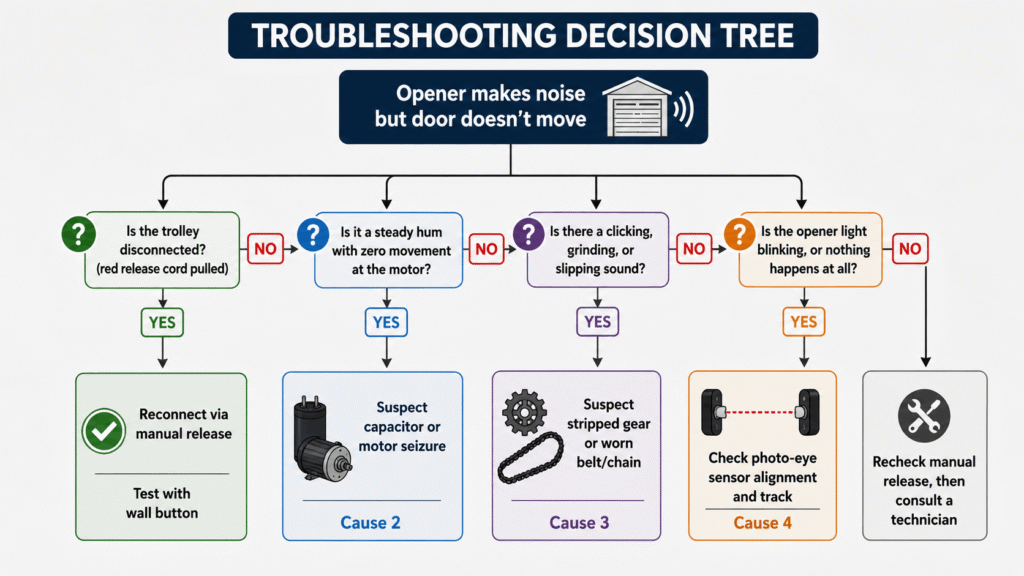
Use this to jump straight to your cause based on what you’re hearing and seeing, without reading every section above.
Opener makes noise but door doesn't move
│
├─ Is the trolley disconnected? (red release cord pulled)
│   YES → Reconnect via manual release → test with wall button
│   NO ↓
│
├─ Is it a steady hum with zero movement at the motor?
│   YES → Suspect capacitor or motor seizure → Cause 2
│   NO ↓
│
├─ Is there a clicking, grinding, or slipping sound?
│   YES → Suspect stripped gear or worn belt/chain → Cause 3
│   NO ↓
│
└─ Is the opener light blinking, or nothing happens at all?
    YES → Check photo-eye sensor alignment and track → Cause 4
    NO → Recheck manual release, then consult a technician
Save or screenshot this decision tree — it covers the four most common causes in one place and works even if you forget the details above.
Want this as a printable checklist you can keep taped inside the garage? That’s exactly the kind of thing our newsletter sends out — sign up and we’ll get you the printable version.
Common Mistakes When Diagnosing This
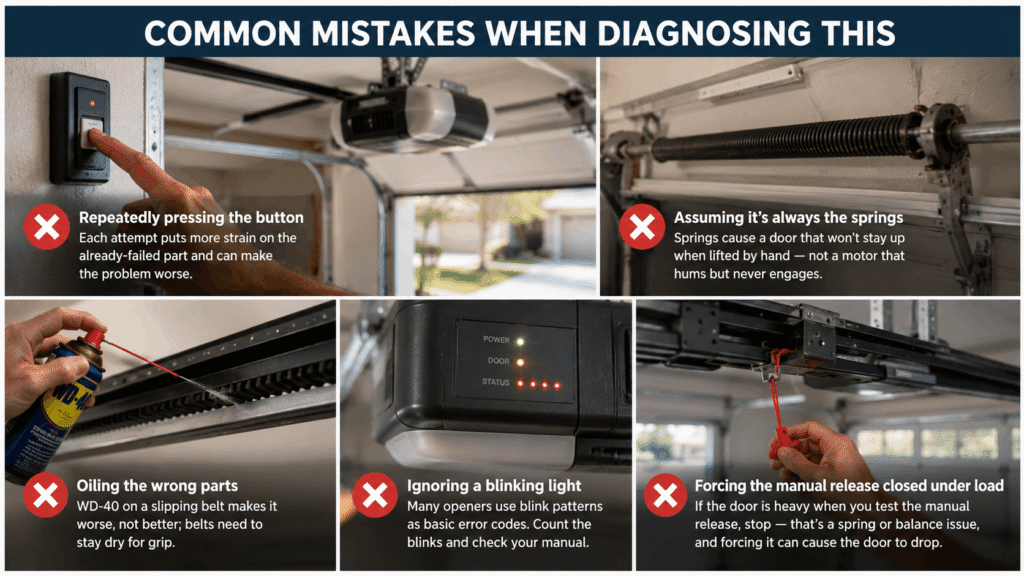
The single biggest mistake is repeatedly pressing the button, hoping the noise resolves itself. Each attempt puts more strain on whichever part has already failed — a slipping belt gets more frayed, a stripped gear loses more teeth, a struggling capacitor runs hotter.
A few others worth naming:
- Assuming it’s always the springs. Springs cause a door that won’t stay up when lifted by hand — not a motor that hums but never engages. Don’t pay for a spring replacement based on this symptom alone.
- Oiling the wrong parts. WD-40 on a slipping belt makes it worse, not better; belts need to stay dry for grip.
- Ignoring a blinking light. Many openers use blink patterns as basic error codes. Count the blinks and check your model’s manual before assuming it’s random.
- Forcing the manual release closed under load. If the door is heavy when you test the manual release, stop — that’s a spring or balance issue, and forcing it can cause the door to drop.
DIY Fix or Call a Professional?
The trolley reconnection, sensor cleaning, and stripped gear replacement are reasonable DIY repairs for most homeowners. They involve no electrical work and use widely available parts.
Call a professional if: the capacitor is suspected (electrical shock risk), the motor housing feels hot or smells burnt, the door itself doesn’t stay open when lifted by hand (spring/cable issue), or you’ve replaced a part and the same noise returns within days — that usually means a related part failed too and needs a trained diagnosis.
What Will It Cost to Fix or Replace?
Most of these fixes fall well under the price of a new opener, which is worth knowing before you assume replacement is the only option. A manual release repair or sensor realignment costs nothing but time. A stripped drive gear or replacement chain/belt typically runs in the parts-plus-labor range rather than requiring a full unit swap.
If the capacitor or motor itself has failed on an opener that’s already 10+ years old, replacement often makes more financial sense than repair. Our garage door opener cost guide breaks down 2026 pricing by repair type versus full replacement, so you can compare before deciding.
FAQs
Why is my garage door making a noise but not opening?
The motor is running but isn’t mechanically connected to the door — most often because the manual release trolley has disengaged, a capacitor is failing to provide starting torque, or a drive belt, chain, or gear has broken. Match the sound (steady hum vs. clicking/grinding) to narrow down which of these applies before attempting a fix.
Why is my garage door opener humming but not opening?
A steady hum with no movement typically points to a failing capacitor, which supplies the motor’s initial starting torque, or a seized motor bearing. Unlike a clicking or grinding sound, a pure hum usually means the motor itself is struggling, not the drive mechanism.
Why is my garage door so noisy when it opens and closes normally?
This is a different issue than a non-moving door — it usually means the rollers, hinges, or track need lubrication, or hardware has worked loose over time. If the door is actually moving, the causes in this article don’t apply; the fix is routine maintenance rather than a mechanical failure.
Why is my garage motor working but the door is not going up?
The motor running without the door moving almost always means the trolley has disconnected from the drive rail via the manual release, or the belt, chain, or drive gear connecting the motor to the door has failed. Check the manual release cord first since it’s the fastest and most common fix.
Is it safe to keep pressing the button when the opener hums but won’t move?
No — repeated attempts add strain to whatever part has already failed, whether that’s an already-slipping belt, a stripped gear, or an overheating capacitor. Stop after the first failed attempt, identify the cause using the sound, and address it before trying again.
What to Do Next
If this didn’t resolve your specific symptom, our garage door opener troubleshooting guide covers issues beyond noise-without-movement, including doors that reverse unexpectedly.
If your door goes down partway and then reverses rather than staying stuck, that’s a distinct issue — see why your garage door goes down halfway then back up.
And if you’re weighing repair against replacement, our 2026 cost guide will tell you which one actually makes financial sense for your opener’s age and the part that’s failed.