
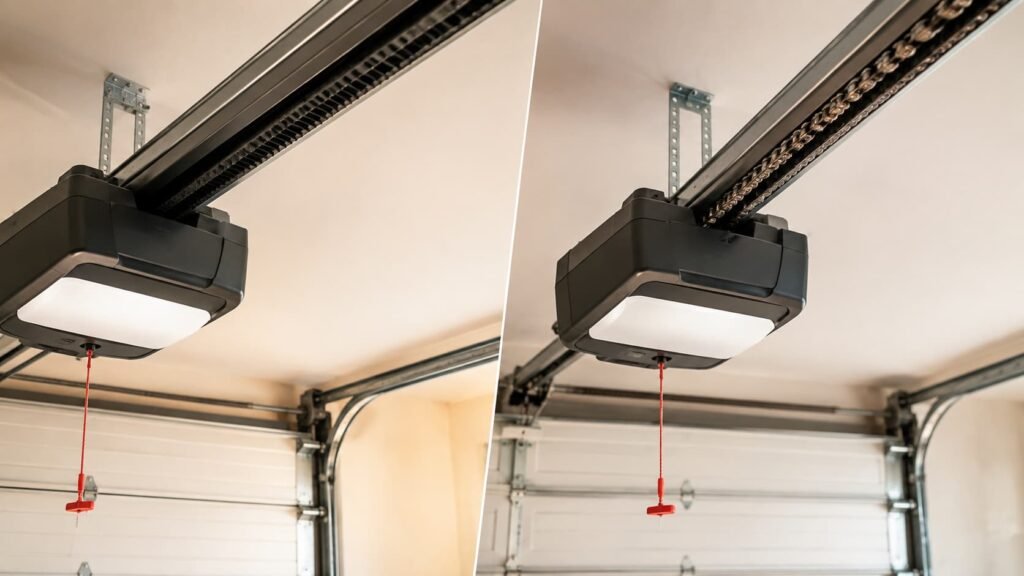
Your garage door opener just died, or you’re finally dealing with the 6 a.m. rattle that wakes the whole house, and now you’re staring at two options that look almost identical on the shelf. The difference between them comes down to what’s actually pulling your door — a reinforced rubber belt or a metal chain — and that one part changes the noise, the price, and how long the unit lasts.
Quick Answer: Belt drive garage door openers use a rubber-and-steel belt for quiet, low-vibration operation and typically cost $30–$80 more than chain drives. Chain drive openers use a metal chain, run louder, and cost less upfront. Choose belt drive if your garage sits under or beside a bedroom; choose chain drive if noise isn’t a factor and you want the lower price.
Table of Contents
What You Need to Know
- Belt drives run roughly 15–20 decibels quieter than chain drives — noticeable through a shared wall or ceiling.
- Chain drives cost less to buy but nothing to install differently; the price gap is in the unit, not the labor.
- Both systems typically last 10–15 years when paired with a quality motor — the drive type doesn’t determine lifespan on its own.
- Belt drives handle cold climates fine with modern rubber compounds; older belt materials were the exception, not today’s models.
- You generally cannot convert a chain drive to belt drive on the same unit — the drive mechanism is built into the opener, not swapped separately.
Belt Drive vs. Chain Drive: The Core Difference
A chain drive garage door opener uses a metal chain, similar to a bicycle chain, to pull the trolley that moves your door along its track. A belt drive opener replaces that chain with a reinforced belt made of rubber, fiberglass, or steel-reinforced polyurethane.
The mechanism is the entire story here: metal-on-metal contact versus rubber-on-track contact is what separates a noisy opener from a quiet one. Chain drives cost less because metal chains are cheaper to manufacture than reinforced belts, but that same metal contact is what generates the vibration and clatter people notice. Belt drives solved that problem by removing the metal-to-metal friction, at a modest cost premium.
Quick Comparison Table
| Factor | Belt Drive | Chain Drive |
|---|---|---|
| Noise level | ~50–55 dB (quiet conversation) | ~70–75 dB (vacuum cleaner range) |
| Unit cost | $180–$350 | $150–$280 |
| Best for | Attached garages, bedrooms above/beside garage | Detached garages, workshops, budget installs |
| Lifespan | 10–15 years | 10–15 years |
| Maintenance | Minimal — no lubrication needed | Occasional chain lubrication (1–2x/year) |
| Cold weather | Fine with modern rubber compounds | No cold-weather sensitivity |
| Vibration | Low — smoother trolley movement | Higher — transmits through the door track |
Save or screenshot this comparison table — it covers the core trade-offs you’ll weigh before buying, without digging through five different spec sheets.
How a Chain Drive Opener Works
A chain drive opener runs a metal chain along a steel rail, connected to a trolley that physically pulls your garage door open and closed. Learn the full mechanics of the motor-and-trolley system in our guide on how a garage door opener works.
The chain needs periodic tension adjustments and occasional lubrication, since metal-on-metal contact wears over thousands of open-close cycles. That wear is also the source of most of the noise — a loose or dry chain gets louder over time, not just from the drive type itself.
How a Belt Drive Opener Works
A belt drive opener uses the same trolley-and-rail system as a chain drive, but the chain is replaced with a reinforced belt. The belt requires no lubrication and generates far less vibration, because there’s no metal striking metal as the trolley moves.
The trade-off is manufacturing cost — reinforced belts capable of handling a garage door’s weight over a decade of use cost more to produce than a standard chain, and that cost is passed on in the unit price.
Which Is Quieter?
Belt drive openers are quieter than chain drives, and the gap is measurable, not just a marketing claim. According to Chamberlain Group’s published product specifications, chain-drive openers typically operate in the 70–75 decibel range — comparable to a vacuum cleaner — while belt-drive models run closer to 50–55 decibels, closer to normal conversation.
If your garage sits directly under or beside a bedroom, that 15–20 decibel gap is the difference between a door that wakes someone up and one that doesn’t. Installation quality still matters here — a poorly mounted belt drive on an unbalanced door can outperform a well-installed chain drive in the wrong direction, so don’t assume the drive type alone guarantees silence.
Cost Comparison (Unit + Installed)
Belt drive openers typically run $30–$80 more than comparable chain drive models at the same horsepower and feature tier. On a $200 chain drive unit, expect to pay roughly $230–$280 for the belt drive equivalent.
Installation labor doesn’t change based on drive type — a professional installer charges the same whether you choose belt or chain, since the mounting process is identical. The entire cost difference lives in the unit itself, not the job.
Which Lasts Longer? Reliability & Maintenance
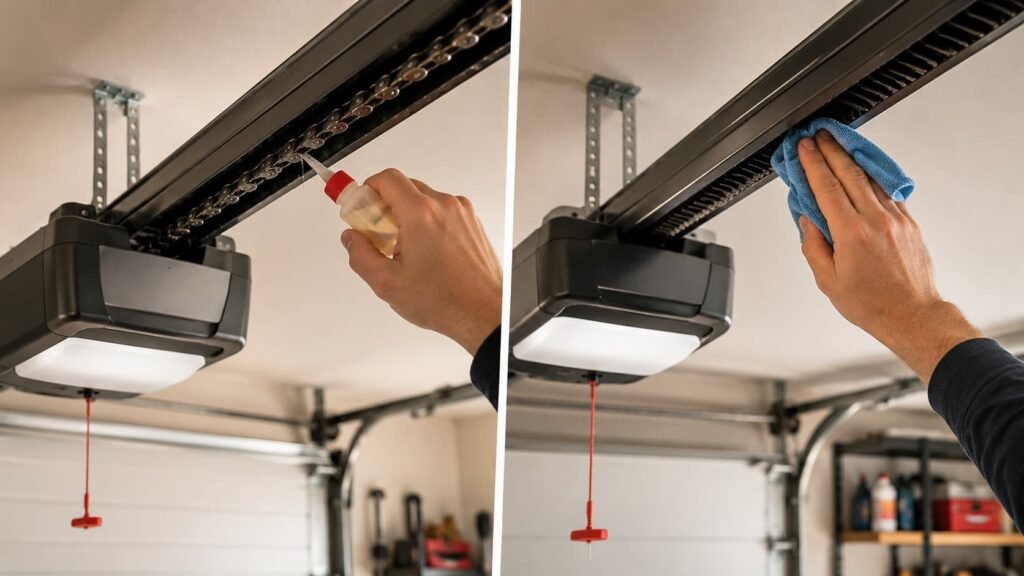
Both drive types typically last 10–15 years, and lifespan depends far more on motor quality, usage frequency, and installation than on whether you chose belt or chain. Neither system has a meaningful reliability edge over the other when properly maintained.
Chain drives need occasional lubrication — roughly once or twice a year — while belt drives need none, since there’s no metal wear point to protect. That makes belt drives marginally lower-maintenance, though the difference is minor if you’re already doing routine garage door checks.
Belt Drive Drawbacks
Belt drive openers aren’t universally better — they cost more upfront, and the belt itself, while durable, is not indestructible. Extreme, repeated overloading (a door well beyond the opener’s rated horsepower) can stress a belt faster than it would a chain, though this is a horsepower-mismatch problem, not a belt-specific weakness. Choosing the correct motor size for your door weight matters more than drive type for avoiding this.
Does Climate Affect Belt Drives?
Modern belt drive openers perform reliably in cold climates. Older rubber compounds used in early belt-drive models were more prone to stiffening in freezing temperatures, but current reinforced belts — typically fiberglass or steel-cable-reinforced polyurethane — are engineered to stay flexible well below freezing.
If you live somewhere with extended sub-zero winters, check the manufacturer’s rated temperature range before buying, since specs vary slightly between brands and belt materials.
Can You Convert an Existing Opener from Chain to Belt Drive?
No — you generally cannot convert a chain drive opener to belt drive. The drive mechanism, rail, and trolley system are manufactured together as a matched set, not sold as interchangeable parts. Switching drive types means replacing the entire opener unit, not just swapping the chain for a belt.
If noise has become a real problem with an existing chain drive opener, the practical fix is a full opener replacement rather than a retrofit.
Which Should You Choose?
Pick belt drive if your garage is attached to the house, sits below or beside a bedroom, or you simply want the quietest option available and the extra $30–$80 isn’t a dealbreaker. Pick chain drive if your garage is detached, used as a workshop, or noise genuinely isn’t a factor in your household — the savings are real and the reliability is identical.
Drive type is only one piece of the decision. Our guide to garage door opener types covers screw drive and direct drive as well, and our motor types breakdown explains how the motor — not just the drive — affects long-term performance.
Choosing the Right Size and Power, Regardless of Drive Type
Belt or chain, the opener still needs to match your door’s weight and size, or you’ll run into strain issues that have nothing to do with noise. Check our horsepower guide to confirm you’re buying enough motor for your door, and use our opener sizing guide if you’re not sure which size fits your setup.
Common Mistakes to Avoid
Assuming belt drive automatically means a silent garage. A belt drive on an unbalanced or poorly lubricated door track can still rattle — the drive type reduces one noise source, not every noise source in the system.
Buying based on drive type alone and ignoring horsepower. An underpowered opener strains regardless of whether it’s belt or chain, and that strain shows up as noise and premature wear either way.
Skipping chain lubrication and blaming the drive type for the noise. A dry, under-tensioned chain gets noticeably louder over time — before assuming you need to switch to belt drive, try a proper lubrication and tension check first.
FAQs
What are the disadvantages of a belt drive garage door opener?
Belt drive openers cost $30–$80 more than comparable chain drives, and while the belt is durable, it can wear faster than a chain if the opener is consistently overloaded beyond its rated horsepower. Otherwise, belt drives have no meaningful reliability disadvantage.
What is the most reliable type of garage door opener?
Reliability depends more on motor quality, horsepower match, and installation than on drive type — belt and chain drives typically both last 10–15 years. Neither has a proven reliability edge over the other when properly sized and maintained.
What is the best drive system for a garage door opener?
There’s no single “best” system — it depends on your priorities. Belt drive wins on noise for attached garages near living spaces; chain drive wins on upfront cost for detached garages or budget-focused buyers.
Can I switch from chain drive to belt drive garage door opener?
No, not on the same unit. The drive mechanism is built into the opener as a matched system, so switching from chain to belt requires replacing the entire opener rather than swapping individual parts.
Is a belt drive opener worth the extra cost?
If your garage is attached to living space or noise bothers you or your household, yes — the $30–$80 premium buys a measurable, permanent noise reduction. If your garage is detached or noise isn’t a concern, the premium isn’t necessary.
What to Do Next
Once you’ve settled on belt or chain, the next decision is sizing the opener correctly — an oversized or undersized motor causes more noise and wear than drive type ever will. Start with our horsepower guide to match power to your door weight, then confirm the right unit size with our sizing guide.