
Your garage door won’t budge, the power just flickered off, and you’re staring at the opener wondering if a dead battery is the actual problem. It’s a fair question — and the answer isn’t a simple yes or no.
Quick Answer: No, the garage door opener’s motor runs on standard 120V home AC electricity, not batteries. Two other parts of the system do use batteries: the wireless remote control (AA or coin-cell) and, on many newer models, an optional battery backup unit that powers the opener temporarily during a power outage.
Table of Contents
What You Need to Know:
- The opener motor itself plugs into a standard household outlet — it has no battery of its own.
- Your handheld remote and wall keypad run on small replaceable batteries (usually AA or CR2032).
- Battery backup systems are an add-on or built-in feature on mid-to-premium models, not a universal standard.
- A charged backup battery typically keeps the door working through several open/close cycles during an outage, not indefinitely.
- Every garage door opener has a manual release cord that disconnects the motor entirely, letting you open the door by hand with zero power.
How the Garage Door Opener Motor Gets Its Power
The motor that actually lifts your garage door draws power from your home’s electrical wiring, the same way a refrigerator or washing machine does. It’s hardwired or plugged into a dedicated outlet in the garage ceiling near the unit.
The motor has no internal battery of any kind — if the outlet loses power, the motor stops working immediately unless a separate battery backup system is installed. This is why so many homeowners are surprised the first time their power goes out and the door simply won’t respond to the remote.
What Actually Runs on Batteries
Two components in a typical garage door opener system are battery-powered, and confusing them is the most common source of the “is it battery powered” question.
The Remote Control
The handheld remote and any wall-mounted keypad run on small batteries — most commonly a single AA, AAA, or CR2032 coin-cell, depending on the brand and model. These batteries only power the transmitter that sends the signal, not the door itself.
If your remote stops responding but the wall button still opens the door normally, a dead remote battery is almost always the cause — not a problem with the opener itself.
The Battery Backup System
A battery backup is a rechargeable battery pack, usually 12V DC, installed inside or alongside the opener’s main unit. It sits idle and trickle-charges during normal operation, then automatically kicks in the moment household power cuts out.
Battery backup is not standard on every opener — it’s a built-in feature on many mid-range and premium models (particularly those meeting certain modern safety-standard requirements) and an optional add-on kit for older units. If you’re not sure whether your opener has one, check for a small battery compartment near the motor housing or in the printed manual.
Battery Backup Runtime & Cycles by Brand
Backup battery performance varies by brand, battery age, and how many accessories (lights, sensors, smart hub) are drawing power from the same unit. Approximate figures reported by major manufacturers:
| Brand / Line | Battery Type | Typical Backup Runtime | Approx. Cycles on Backup |
|---|---|---|---|
| Chamberlain (battery-backup models) | 12V rechargeable | Several hours to ~1 day standby | ~10–20 full open/close cycles |
| LiftMaster (battery-backup models) | 12V rechargeable | Several hours to ~1 day standby | ~10–20 full open/close cycles |
| Genie (Aladdin Connect / backup models) | 12V rechargeable | Several hours standby | ~10–20 full open/close cycles |
| Craftsman (battery-backup models) | 12V rechargeable | Several hours standby | ~10–20 full open/close cycles |
Figures above are general industry ranges based on typical 12V backup battery specifications — exact runtime and cycle counts vary by specific model year and should be confirmed against your unit’s manual before relying on them in an outage.
Save or screenshot this runtime and cycle table — it’s the fastest way to gauge whether your specific opener can get you through a multi-hour outage.
What Happens When the Power Goes Out?
If your opener has no battery backup, the motor stops completely and the remote and wall keypad become useless until power returns. This is by design, not a malfunction.
Every garage door opener includes a manual release cord — a red-handled rope hanging from the trolley rail — that disconnects the door from the motor. Pulling it lets you lift and lower the door entirely by hand, regardless of power status. This is the safe, standard way to get a vehicle in or out during an outage.
Manual release is a required safety feature under UL 325, the industry safety standard for automatic residential garage door operators, so every legally sold opener in the U.S. has one. UL 325’s entrapment-protection requirements are also codified into federal law by the Consumer Product Safety Commission, which means the manual release requirement isn’t just an industry recommendation — it’s a legal one.
Is a Battery Backup Worth Adding?
For most homeowners, the honest answer is: it depends on how often your area loses power and how much you rely on the garage as your primary entrance.
If you live somewhere prone to storms, grid instability, or extended outages, a battery backup removes the daily inconvenience of manually cranking the door open. If outages are rare where you live, the manual release cord is a perfectly adequate fallback and you may not need to spend extra on a backup-equipped model.
If you’re shopping for a new opener with this feature built in, our comparison of garage door opener types breaks down which models include battery backup standard versus as an add-on.
Common Mistakes and Troubleshooting
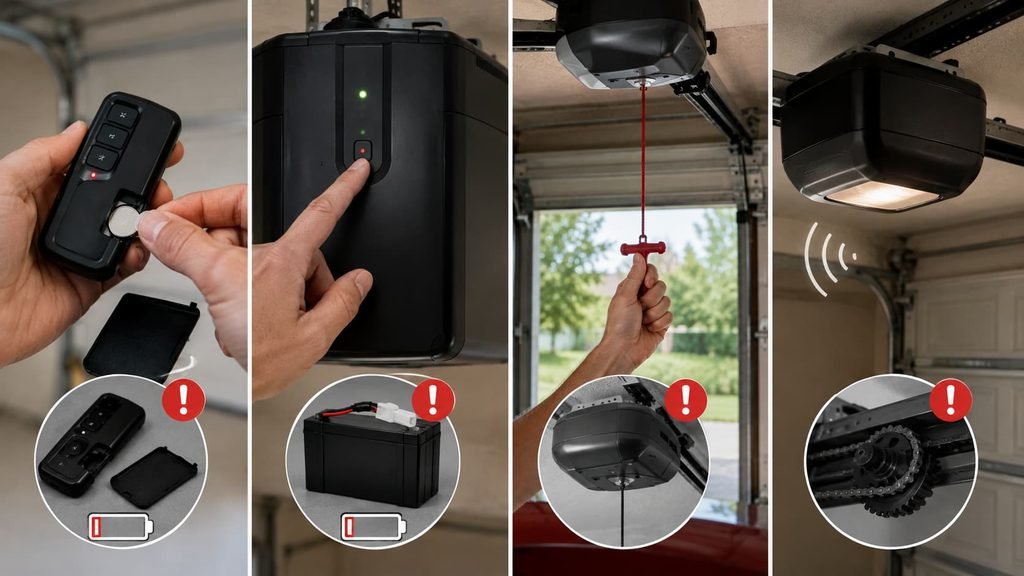
Assuming a dead remote means a dead opener. Swap the remote battery first — it’s the cheapest, fastest fix and solves the majority of “my garage door stopped working” complaints.
Never testing the backup battery until an outage happens. Backup batteries degrade over 2–5 years even if never used. Most systems have a status LED — check it periodically rather than discovering it’s dead mid-outage.
Forgetting the manual release exists. Homeowners without a backup battery sometimes assume they’re stuck during an outage. Pulling the red release cord takes seconds and works on every compliant opener sold in the U.S.
Ignoring unusual motor sounds or slow cycling as “just old age.” A motor working harder than it should often points to worn components rather than the power source — our breakdown of garage door opener motor types covers what those symptoms usually mean.
FAQs
Do garage door openers work without electricity?
Not through the motor — but yes, functionally. If the opener has no battery backup, the door won’t respond to the remote or wall button during an outage. Every opener includes a manual release cord that disconnects the motor so you can open the door by hand regardless of power status.
How long does a battery last on a garage door opener?
Two different batteries are involved. Remote control batteries typically last 1–2 years with normal use. Battery backup units are rechargeable and generally last 2–5 years before needing replacement, with actual outage runtime of several hours to about a day depending on the model and battery age.
How many times can you open a garage door with a battery backup?
Most 12V battery backup systems support roughly 10–20 full open/close cycles on a single charge, though this varies by brand, battery condition, and whether accessories like lights or smart-home modules are drawing extra power from the same battery.
How do garage door openers get power?
The motor draws standard 120V AC power from a household outlet, the same as most large appliances. The remote and keypad run on small replaceable batteries, and an optional battery backup unit — where installed — supplies temporary power during outages.
Does my garage door remote use batteries?
Yes. Virtually all garage door remotes and wall keypads run on small batteries, commonly AA, AAA, or CR2032 coin-cell, depending on the manufacturer. This is separate from the opener’s main power source and separate from any battery backup system.
What to Do Next
If your opener currently has no battery backup and outages are common where you live, start by checking which opener types include it standard. If you’re weighing a full replacement, see current garage door opener costs to budget for a backup-equipped model. And if your existing motor already seems to be struggling independent of power source, review the common motor types and failure signs before assuming it’s a battery issue.