
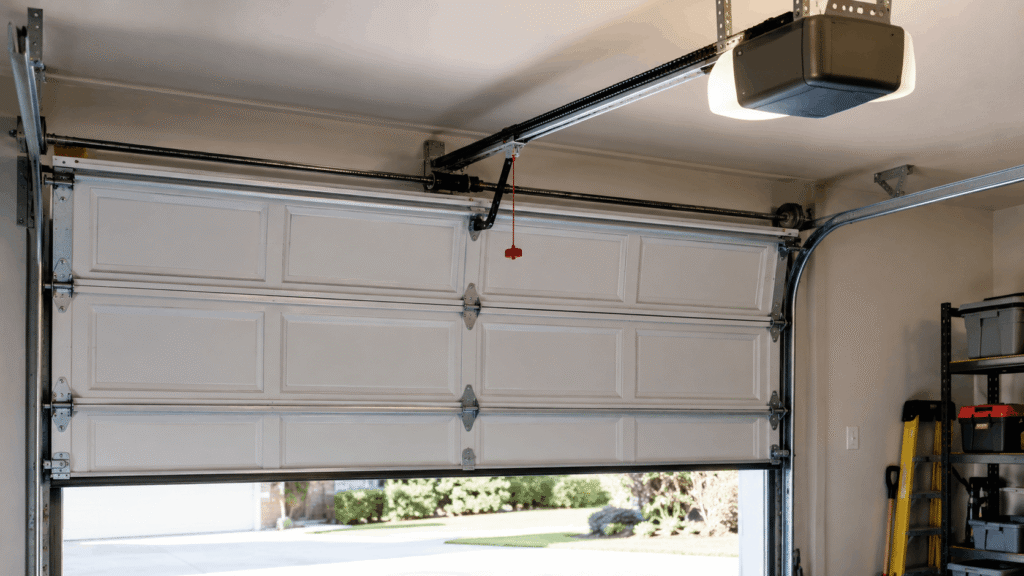
Your garage door froze mid-travel and now it won’t budge in either direction. In most cases this is a safe, five-minute fix you can diagnose yourself before calling anyone.
Quick Answer: A garage door stuck halfway is usually caused by misaligned photo-eye sensors, an opener limit setting that’s drifted out of adjustment, or spring tension that’s no longer balanced enough for the opener to lift the door. Check the sensors first — it’s the fastest fix and the most common cause.
Table of Contents
What You Need to Know
- Check the two photo-eye sensors near the floor track first — a knocked-out-of-alignment sensor is the single most common cause of a mid-travel stop.
- If the door stops at the exact same spot every time, the opener’s limit setting is the likely culprit, not the sensors.
- A door that only sticks on one side points to a track, cable, or spring problem — not the opener at all.
- Never force a stuck door by hand while the opener motor is still engaged — disconnect it first.
- If the springs are visibly stretched, snapped, or uneven, stop troubleshooting and call a technician — springs are under enough tension to cause serious injury.
What to Do First If Your Door Is Stuck Halfway
Stop pressing the remote repeatedly — that’s the first thing to fix, and it’s the mistake almost everyone makes.
- Stop clicking the remote or wall button. Repeated attempts can burn out the opener motor or strip the drive gear if something mechanical is jammed.
- Look at the track for anything blocking it — a fallen tool, a toy, ice buildup, or debris on either side of the door.
- Check the two photo-eye sensors, mounted about 6 inches off the floor on each side of the track. A blinking light on either one usually means it’s misaligned or blocked.
- Pull the emergency release cord (the red handle hanging from the opener rail) only if you need to move the door manually — see the manual-release section below before you do this.
- Note exactly where the door stopped. Same spot every time versus a random spot each time points to two completely different problems, covered next.
Why Is My Garage Door Opening Halfway? (Most Common Causes)
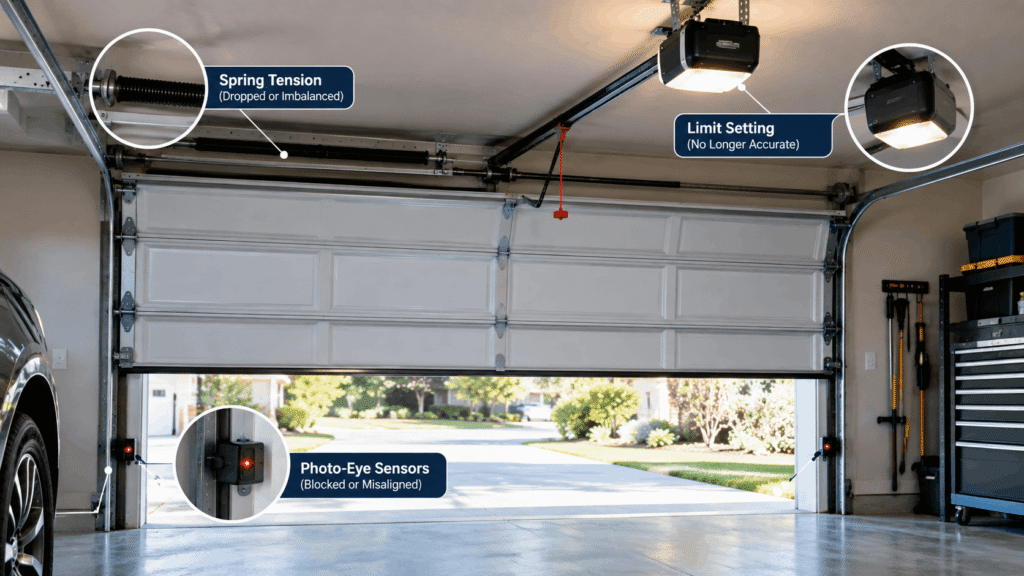
Three things cause the vast majority of mid-travel stops: blocked or misaligned photo-eye sensors, an opener limit setting that no longer matches the door’s actual travel distance, and spring tension that’s dropped below what the opener needs to finish the lift. Each has a different fix, and only one of them is something you should touch yourself.
Misaligned or Blocked Photo-Eye Sensors
Photo-eye sensors are a safety feature required on residential garage door openers — they send an invisible beam across the bottom of the track, and if that beam is broken, the opener assumes something is in the door’s path and refuses to continue closing, and on some models, will also stop or reverse an opening cycle.
A bumped ladder, a shifted storage shelf, or even direct sunlight hitting one sensor at a certain time of day can throw the alignment off by a few degrees — enough to trigger a stop. Both sensor lights should glow solid, not blink, when the door is idle. If one is blinking, loosen its wing nut, nudge it gently until both lights turn solid, and retest.
Limit Setting Drift
The limit setting tells the opener exactly how far to travel before it should stop — measured in the opener’s internal memory, not by a physical marker. Over months of use, chain slack, temperature swings, or a recent battery change can shift that setting by an inch or two, and the opener starts stopping short of full open every single time.
This shows up as a door that stops at the identical spot on every cycle — the giveaway that separates it from a sensor or spring issue, which tend to be inconsistent.
Spring Tension Imbalance
Garage door openers are not designed to lift the full weight of the door — the torsion or extension springs do that work, and the opener just guides the door along the track. When a spring loses tension (from age, a partial crack, or simple wear), the opener tries to compensate and can stall partway up because it’s fighting more resistance than it’s built for.
Residential torsion springs are typically rated for around 10,000 open-close cycles before they need replacement — for an average household, that works out to roughly 7–10 years of daily use. If your door is stopping in the same general area and feels unusually heavy when you manually lift it, treat this as a spring problem, not an opener problem, and skip to the professional-help section below.
My Garage Door Is Stuck on One Side
A door that hangs crooked or stops with one side higher than the other almost never means the sensors or the opener are at fault — it points to something mechanical on that specific side. Look for a bent track, a roller that’s jumped its channel, or a cable that’s slipped off the drum, all on the side that’s lagging behind.
Don’t try to force the door level by pulling on the low side — if a cable has slipped or a spring is unevenly worn, the door can shift suddenly and unpredictably. This is one of the few garage door symptoms where calling a technician before you touch anything else is the safer call, because diagnosing which of three components failed usually requires removing panels to see the track and cable path directly.
Roller Garage Doors: Is This Different?
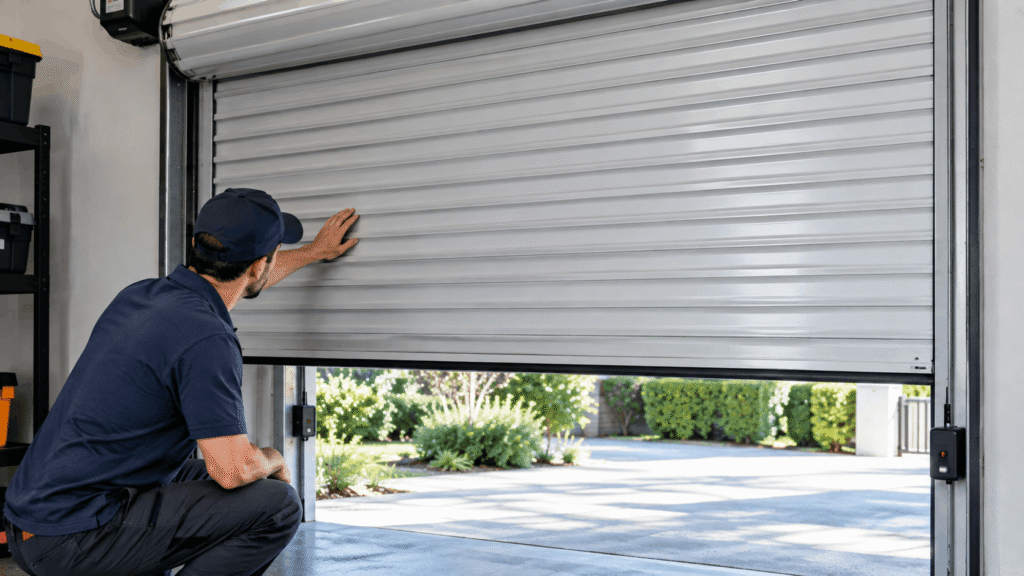
Roller doors use a curtain of interlocking slats instead of rigid panels, so a halfway stop is more often a guide-track alignment issue than a spring problem. The core troubleshooting order is the same — check for an obstruction, check the sensors if your roller door has them, then check the guide channels on both sides for debris or a bent section.
The one meaningful difference: roller door curtains can bind or bunch if even one slat gets slightly bent, which stops the whole door from a single small point of damage. Run your hand along the visible curtain (with the opener disconnected) and feel for anything that isn’t lying flat.
Diagnose It Yourself: Troubleshooting Decision Tree
| Symptom | Most likely cause | What to check |
|---|---|---|
| Stops at the exact same spot every time | Limit setting drift | Opener’s limit adjustment settings |
| Stops at a different spot each time | Photo-eye sensor issue | Sensor alignment, sensor lens for dirt/glare |
| Stops and one side is visibly lower | Track, cable, or spring on that side | That side’s track and cable — call a pro |
| Door feels heavy when lifted by hand | Spring tension loss | Springs — call a pro, do not adjust yourself |
| Roller door binds at one point | Bent slat or debris in guide channel | Guide channels on both sides |
Save or screenshot this diagnostic table — it covers the four most common halfway-stop patterns and points you straight to the fix without guesswork. If you’d rather have a printable version to keep in the garage, our newsletter subscribers get a downloadable version of this exact checklist along with seasonal opener-maintenance reminders.
How to Safely Manually Open a Stuck Door
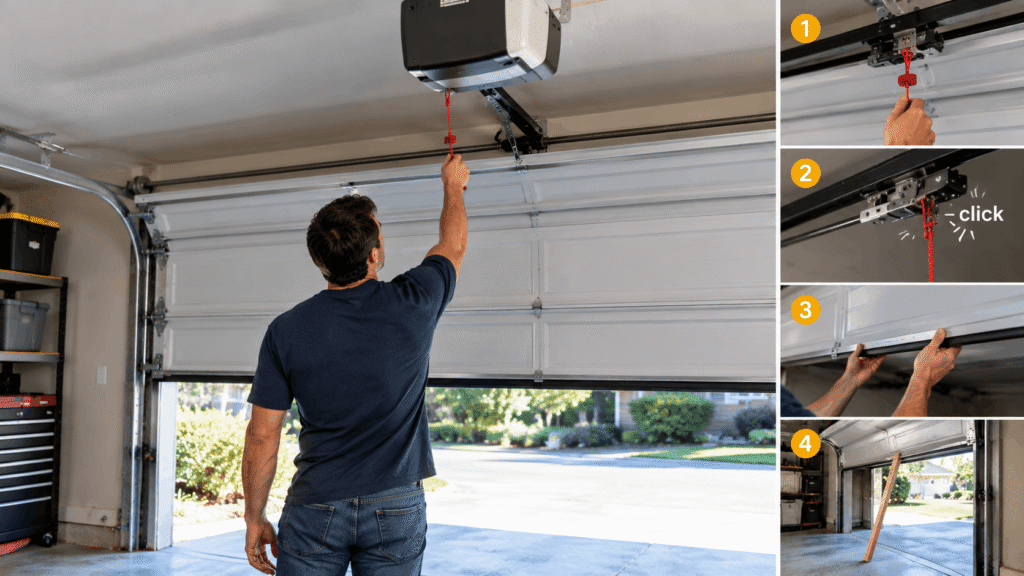
- Locate the emergency release cord — a red handle hanging from a track on the opener’s trolley, usually within arm’s reach of a standing adult.
- Pull the cord straight down and toward the door to disconnect the trolley from the opener carriage. You’ll hear a distinct click when it releases.
- Lift the door by hand slowly, using both hands centered under the bottom panel, not from one corner.
- Stop immediately if the door feels heavier than expected or won’t move past a certain point — that’s a spring, not an obstruction, and pushing past it risks the door falling.
- Once open, prop it with a sturdy support if you need to leave it that way, since a manually-released door has no automatic braking.
- To reconnect the opener, pull the release cord toward the motor unit, then run the opener through one full cycle to re-engage the trolley.
Common Mistakes People Make With a Stuck Door
- Repeatedly clicking the remote. This is the fastest way to turn a five-minute sensor fix into a burned-out motor.
- Adjusting the limit settings before ruling out sensors. Changing the limit setting on a door that actually has a sensor problem just masks the real issue and can cause the door to slam into the floor or over-travel at the top.
- Forcing a door that’s stuck on one side. This is the scenario most likely to end in an ER visit, not a repair bill.
- Ignoring a recurring halfway stop because “it eventually goes up.” An intermittent limit or sensor issue tends to get worse, not better, on its own.
When to Stop Troubleshooting and Call a Professional
Anything involving the springs, cables, or a door that’s stuck unevenly on one side is professional territory — the tension involved can cause serious injury, and it’s not a place to learn by trial and error. Photo-eye alignment and limit-setting adjustments are reasonable DIY tasks; spring and cable work is not.
If you’ve checked the sensors, confirmed the limit setting isn’t the pattern, and the door still won’t move evenly, that combination of symptoms points to a spring or cable technician visit rather than another round of troubleshooting. [CONTENT GAP: link a “Request a Repair” or local technician page here once one exists on the site — currently there’s nowhere to send this reader.]
FAQs
How do I fix a garage door stuck halfway?
Start by checking the two photo-eye sensors near the floor — make sure both lights are solid, not blinking, and that nothing is blocking the beam between them. If the sensors check out and the door stops at the same spot every time, the opener’s limit setting likely needs adjustment. If the door feels heavy or stops unevenly, stop and call a technician.
Why is my garage door opening halfway?
The most common reasons are a misaligned photo-eye sensor, a limit setting that no longer matches the door’s true travel distance, or spring tension that’s worn down enough that the opener can’t finish the lift. Each has a different fix, and the pattern of where the door stops usually tells you which one you’re dealing with.
My garage roller door is stuck halfway open. What can I do to fix it?
Check the guide channels on both sides of the curtain for debris, ice, or a bent section, since roller doors bind more often from a track obstruction than from a spring issue. Run a hand along the curtain with the opener disconnected to feel for any slat that isn’t lying flat, and clear or straighten it before retrying.
My garage door is stuck on one side. What can I do to fix it?
A door hanging unevenly points to a track, cable, or spring problem on that specific side, not the opener or sensors. Don’t try to force the door level by hand, since a slipped cable or uneven spring can cause sudden, unpredictable movement — this is one of the few garage door symptoms best left to a technician.
Is it safe to leave a garage door stuck halfway overnight?
It’s not ideal from a security standpoint, but it won’t damage the door further as long as you don’t keep forcing it with the remote. If you can safely manually close it using the emergency release cord, do that; if it’s stuck due to a suspected spring issue, leave it as-is and address it in daylight.
What to Do Next
If sensors and limit settings check out but the problem keeps coming back, our Garage Door Opener Troubleshooting Guide walks through the wider set of opener issues beyond a halfway stop. If your opener is running but the door isn’t moving at all rather than stopping partway, that’s a different symptom covered in Garage Door Opener Making Noise But Not Moving? Here’s Why. And if this is one of several opener issues you’ve noticed lately, 9 Common Garage Door Opener Problems and How to Fix Them is the broader diagnostic starting point.