
Your garage door opener just died, or you’re staring at a new-build garage with no opener installed at all—and now you’re facing five different “types” with names that mean nothing to you yet. Fifteen minutes from now, you’ll know exactly which one fits your door, your garage layout, and your budget.
Quick Answer: There are three core garage door opener drive types — chain, belt, and screw — plus two specialized variants: direct drive and jackshaft (wall-mount). Chain drives are the most affordable and powerful; belt drives are the quietest; screw drives need the least maintenance; jackshaft openers suit garages with low ceiling clearance.
Table of Contents
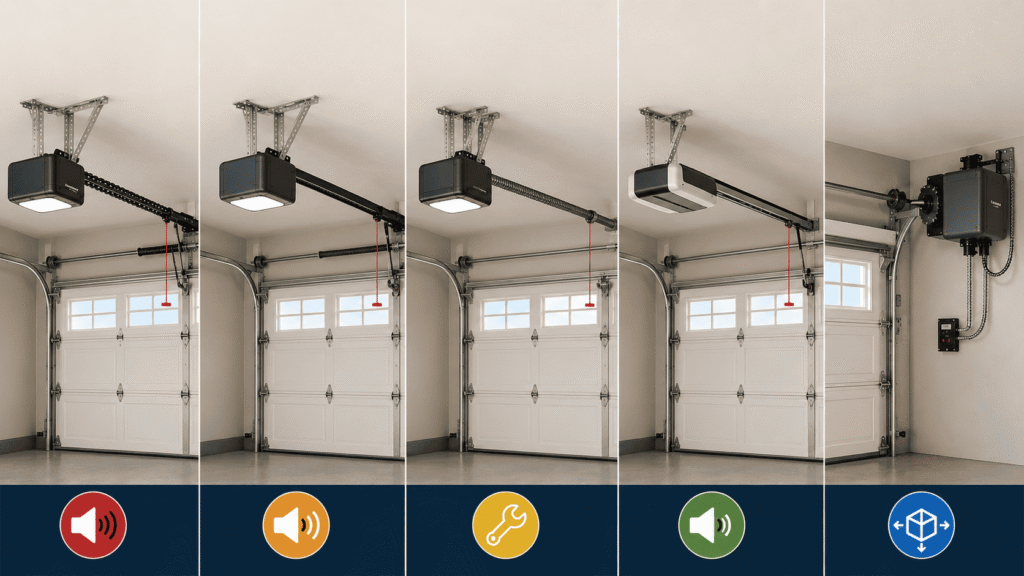
What You Need to Know
- Chain drive costs the least ($120–$250) and handles the heaviest doors, but it’s the loudest.
- Belt drive runs almost silently — the right pick for garages under or beside a bedroom.
- Screw drive has the fewest moving parts, so it needs less maintenance but performs poorly in extreme temperature swings.
- Jackshaft openers mount on the wall beside the door instead of on the ceiling—the only real option if you have under 12 inches of ceiling clearance.
- Most standard residential doors run fine on a 1/2 HP opener; insulated or oversized doors need 3/4 HP or higher.
Types of Garage Door Openers at a Glance
Garage door openers are grouped by drive mechanism — the system that moves the trolley along the rail to lift the door. Five types cover nearly every residential situation: chain, belt, screw, direct drive, and jackshaft.
The “3 vs. 5 types” confusion comes down to scope: chain, belt, and screw are the three traditional rail-drive systems, while direct drive and jackshaft are newer, purpose-built variants that solve specific problems (noise and clearance, respectively).
Comparison Table — All Opener Types
Type Noise Level Avg. Cost (Opener Only) Maintenance Best For Typical Lifespan Chain Drive Loud (metal-on-metal): $120–$250 Needs periodic lubrication Detached garages, heavy doors 10–15 years Belt Drive Very quiet, $180–$350 minimal Attached garages, bedrooms nearby, 10–15 years Screw Drive Moderate $150–$280 Low, but sensitive to temperature Single-car garages, mild climates 10–15 years Direct Drive: Quietest available, $250–$450 Very low, fewer moving parts Noise-sensitive homes, smart-home setups 15–20 years Jackshaft (Wall-Mount) Quiet ($300–$500) Low-clearance ceilings, storage above doors 10–15 years
Chain Drive Openers
A chain drive opener uses a metal chain to pull the trolley along a rail, lifting the door—the same basic mechanism garage door openers have used for decades. It’s the workhorse of the industry because chains handle heavy loads without stretching or slipping.
The tradeoff is noise. The chain rattles against the rail with every cycle, which is why installers rarely recommend it for garages attached to living spaces. If your garage sits detached from the house, or you simply don’t mind the sound, chain drive delivers the most lifting power per dollar.
Belt Drive Openers
A belt drive opener replaces the metal chain with a reinforced rubber or fiberglass belt, cutting vibration and noise dramatically. Homeowners upgrading specifically to stop waking a light sleeper almost always land here.
Belt drives cost roughly $60–$100 more than a comparable chain drive but require less lubrication over time, since rubber doesn’t need the periodic oiling a metal chain does. For garages under a bedroom, this is the type worth the premium.
Screw-drive openers
A screw drive opener moves the trolley along a threaded steel rod that spins to raise and lower the door, instead of a chain or belt. Fewer moving parts means less to maintain—no lubrication schedule, no chain tension to adjust.
The catch: screw drives are sensitive to temperature extremes. In climates with hard freezes or heavy summer heat, the metal rod expands and contracts, which can cause the opener to run rougher or need more frequent adjustment than chain or belt systems.
Direct Drive Openers
A direct drive opener has a motor that travels along a stationary chain built into the rail itself, rather than a chain or belt pulling a separate trolley. This design has the fewest moving parts of any opener type, which is why it’s both the quietest option and typically the longest-lasting.
Direct drive units cost more upfront—often $100–$200 above a standard chain drive—but the 15–20 year typical lifespan and near-silent operation make it the standard choice in newer smart-home installations where WiFi control and low noise both matter.
Jackshaft (Wall-Mount) Openers
A jackshaft opener mounts on the wall beside the garage door and uses a torsion shaft mechanism to lift it, instead of a rail running across the ceiling. This frees up the entire ceiling for storage, workshop space, or a car lift.
Jackshaft openers exist to solve one specific problem: garages with less than 12 inches of clearance between the top of the door and the ceiling can’t fit a standard rail-mounted opener at all. If that’s your situation, this isn’t a preference — it’s the only type that will physically work.
Chain vs. Belt Drive: Which Should You Choose?
Chain and belt drives are functionally identical in lifting mechanism—a trolley pulled along a rail—differing only in what pulls it. Choose chain drive for maximum lifting power at the lowest price; choose belt drive when noise matters more than cost.
A detached garage with no living space nearby rarely benefits from paying extra for quiet operation. An attached garage below or beside a bedroom almost always justifies the belt drive premium—the noise difference is immediately noticeable, not marginal.
How Much HP Do You Need?
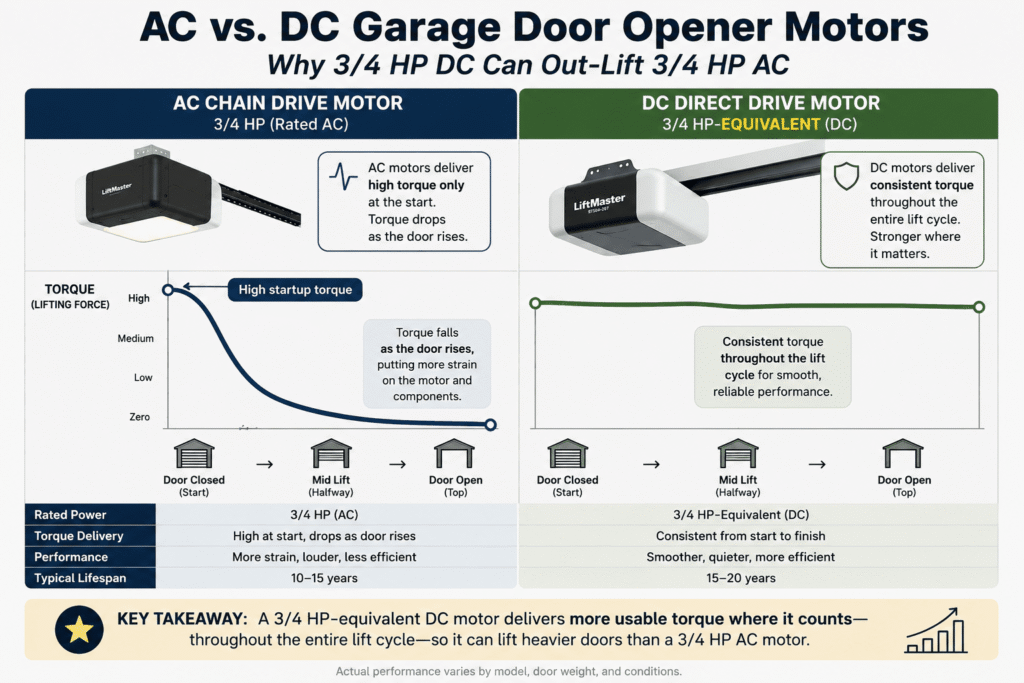
Most single-car and standard double-car residential garage doors run reliably on a 1/2 HP opener; insulated, oversized, or heavier wood doors need 3/4 HP or more. Horsepower rating on the box doesn’t always match real-world lifting force, which is the detail most buying guides skip.
AC chain-drive motors are rated in horsepower, but DC motors used in direct-drive and many belt-drive openers are rated in torque or lifting force and often outperform an equivalent-HP AC motor. A 3/4 HP-equivalent DC opener can lift a heavier door than a genuine 3/4 HP AC chain drive because DC motors deliver consistent torque throughout the lift cycle instead of peaking only at startup.
Which Type Fits Your Garage? Decision Matrix
Door Weight Material Ceiling Clearance Recommended Type: Minimum HP Light (under 130 lbs) Aluminum, single-panel standard (12″+) Belt or Chain 1/2 HPMedium (130–300 lbs) Steel, non-insulated standard (12″+) Chain or Screw 1/2–3/4 HP Heavy (300+ lbs) Insulated steel or wood standard (12″+) Chain or high-torque DC direct drive 3/4–1.25 HP Any weight Any material low (under 12″) Jackshaft (wall-mount) Varies by model
Save or screenshot this decision matrix—it covers the four most common garage configurations and maps each one directly to a recommended opener type and minimum HP, according to standard sizing guidance from the Door and Access Systems Manufacturers Association (DASMA).
Common Mistakes When Choosing an Opener Type
Buying based on price alone is the most reported mistake — a $120 chain drive on a 350-lb insulated door will work initially, then wear out its gears in half the expected lifespan because it’s constantly running near maximum load.
Ignoring ceiling clearance until installation day is the second-most common issue. Measure the distance between the top of the closed door and the ceiling before buying — not after the opener arrives and won’t fit.
Assuming all “3/4 HP” openers are equal trips up buyers comparing an AC chain drive against a DC belt or direct drive side by side. Compare lifting force or torque rating, not just the HP number printed on the box.
Every opener sold for residential use should carry UL (Underwriters Laboratories) safety certification — confirm this before buying, regardless of type.
Want the full breakdown on how these openers actually work day to day, including the safety features every modern unit should have? Our guide on what a garage door opener is and how it works covers the mechanics in depth.
If you’d rather not cross-reference specs every time you shop for garage hardware, our newsletter sends a free opener buying checklist PDF plus periodic guides like this one straight to your inbox—no spam, just the reference material.
FAQ
Which type of garage door opener is most reliable?
Direct-drive openers are generally the most reliable long-term, with a typical 15–20 year lifespan versus 10–15 years for chain, belt, and screw-drive units. Fewer moving parts means fewer components that can wear out or need adjustment over time.
Should I get a 1/2 HP or 3/4 HP garage door opener?
Standard single or double residential doors under 300 lbs typically run fine on 1/2 HP. Insulated, oversized, or wood doors over 300 lbs need 3/4 HP or higher. When in doubt, size up—an underpowered opener strains its motor and gears prematurely.
What are the three types of garage door openers?
The three traditional drive types are chain, belt, and screw. Two additional specialized types — direct drive and jackshaft (wall-mount) — have become common enough that most comparisons now cover five types total.
Is LiftMaster or Chamberlain better?
Both are reputable, widely available brands rather than different opener types—Chamberlain actually owns LiftMaster. Choosing between them comes down to specific model features (smart-home integration, battery backup) rather than one brand outperforming the other across the board.
What are the top 3 garage door openers?
This depends on drive type, budget, and specific features like smart-home compatibility, so there’s no single universal “top “3”—the right opener is the one matching your door weight, ceiling clearance, and noise tolerance from the comparison table above.
What to Do Next
Now that you know which opener type fits your door and garage layout, two things determine whether the install goes smoothly:
- Confirm the mechanics and safety features you’re buying into by reading What Is a Garage Door Opener? How It Works, Safety Features & Expert Tips.
- Measure your ceiling clearance and door weight using the decision matrix above before you shop — this alone prevents the two most common buying mistakes.
- [Once published, browse our belt drive and chain drive buying guides for specific model recommendations by budget.]
Pingback: How Does a Garage Door Opener Work? Full Breakdown
Pingback: Average Cost of a Garage Door Opener (2026 Price Guide)
Pingback: Are Garage Door Openers Battery Powered? The Real Answer