
You hit the button and the door stops halfway. Or it closes, then reverses back up on its own. Or worse — it’s been cycling open and shut with nobody near the remote. Whatever version you’re dealing with right now, the fix is almost never the motor itself.
Quick Answer: Most garage door opening and closing problems trace back to four causes: misaligned safety sensors, incorrect limit switch settings, an obstruction in the door’s track, or worn drive gears. Start with the sensors, since they’re the most commonly misdiagnosed cause, then work through limit switches, the track, and the gears in that order.
Table of Contents
What You Need to Know:
- Sensor misalignment causes most “won’t close” and “reverses before closing” complaints — check them first, every time.
- A door opening or closing by itself usually points to signal interference, a stuck remote button, or worn internal gears — not a haunted garage.
- Federal law has required a secondary safety reversal system on every U.S. residential opener manufactured since January 1, 1993.
- Most fixes below take under 15 minutes and need no tools beyond a screwdriver and a soft cloth.
- If your door won’t stay open on its own or the cable looks frayed, stop troubleshooting the opener and call a technician — that’s a spring or cable issue, not an electronics issue.
The 4 Most Common Causes (At a Glance)
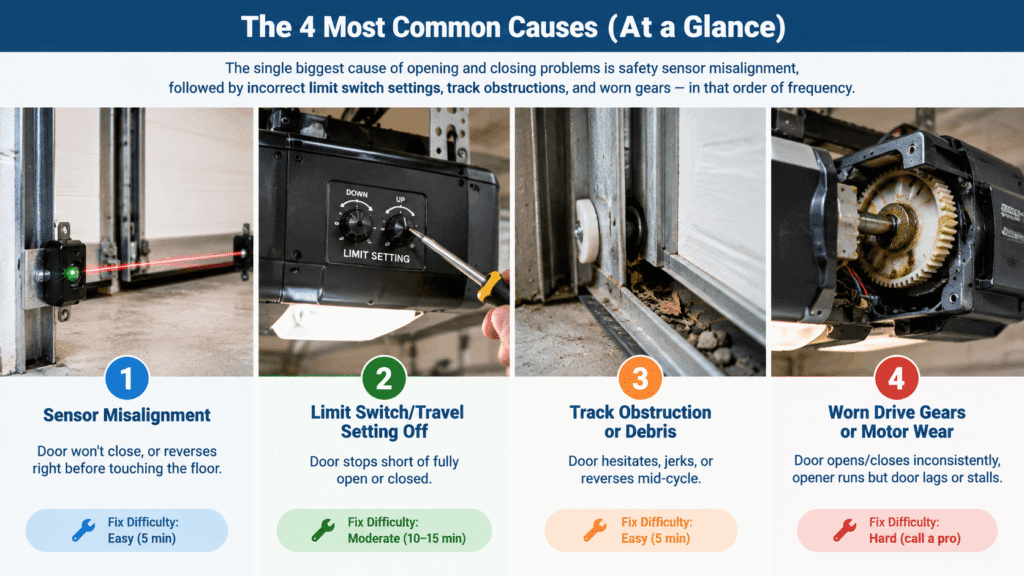
The single biggest cause of opening and closing problems is safety sensor misalignment, followed by incorrect limit switch settings, track obstructions, and worn gears — in that order of frequency.
| Cause | Symptom | Fix Difficulty |
|---|---|---|
| Sensor misalignment | Door won’t close, or reverses right before touching the floor | Easy (5 min) |
| Limit switch/travel setting off | Door stops short of fully open or closed | Moderate (10–15 min) |
| Track obstruction or debris | Door hesitates, jerks, or reverses mid-cycle | Easy (5 min) |
| Worn drive gears or motor wear | Door opens/closes inconsistently, opener runs but door lags or stalls | Hard (call a pro) |
Save or screenshot this table — it covers the fastest way to narrow down your specific problem before you touch anything on the motor unit.
Door Won’t Open or Close Fully
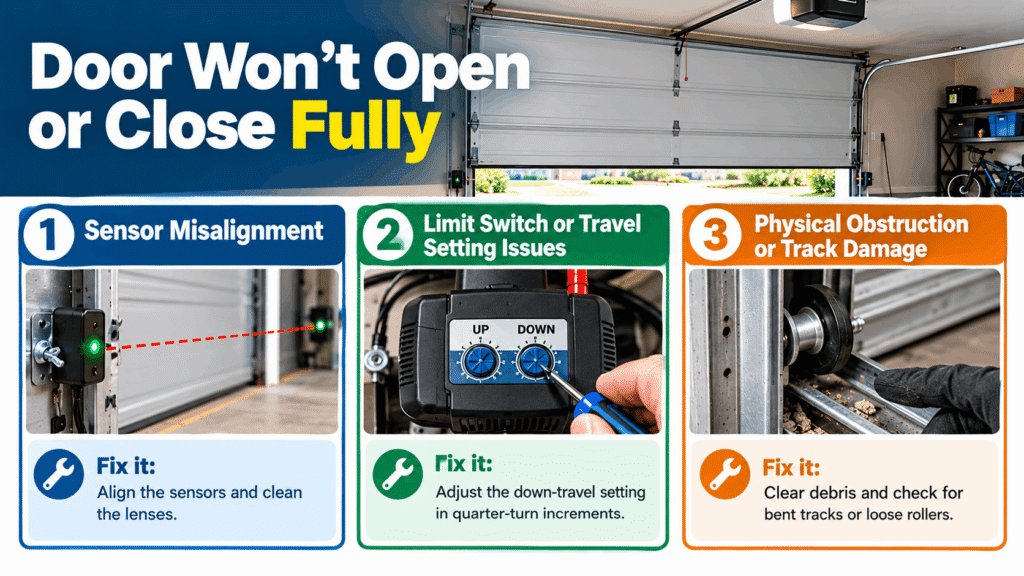
A door that won’t complete its cycle is almost always being told to stop by a safety system, not failing mechanically.
Openers are designed to err on the side of caution. If any part of the safety chain reports a problem, the door stops or reverses rather than risking a slow crush injury — if you want the full rundown on how these components normally work together, What Is a Garage Door Opener? covers the fundamentals. Three sources cause the vast majority of these stalls.
Sensor Misalignment
Every opener built since 1993 uses a pair of photo-eye sensors mounted about 4 to 6 inches above the garage floor, one on each side of the door track. They send an invisible infrared beam across the opening. If that beam is broken or the sensors aren’t pointed at each other, the opener assumes something is blocking the door and refuses to close.
Look at the small LED light on each sensor. A solid, steady light usually means the sensors are aligned and talking to each other. A blinking or flickering light means they’ve drifted out of alignment — often from someone bumping a bike, a broom, or a car mirror into the bracket.
Fix it: Loosen the wing nut or mounting screw on each sensor, gently nudge them toward each other while watching the LED, and re-tighten once the light goes solid. Wipe the lenses with a dry cloth first — dust and spiderwebs block the beam just as effectively as a misaligned bracket.
Limit Switch or Travel Setting Issues
The limit switches tell the opener exactly how far up and down the door should travel before stopping. If these are set incorrectly, the door thinks it has reached the floor when it hasn’t, or thinks it’s fully open when there’s still six inches to go — and it reverses or stalls trying to correct.
Fix it: Most motor units have two adjustment screws or dials, usually labeled “up” and “down” travel, near the back panel. Turn the down-travel adjustment in small increments — a quarter turn at a time — and test the door after each adjustment until it closes fully and stops cleanly at the floor.
Physical Obstruction or Track Damage
A bent track, a loose roller, or something as small as a pebble caught in the track rail can make a door hesitate or reverse mid-cycle, and the opener reads that resistance as an obstruction.
Fix it: Run the door through a full cycle while watching the tracks on both sides. Look for gaps between the rollers and the rail, visible dents, or debris. Clear anything loose, and if a track section looks bent, don’t force the door through more cycles — that stresses the opener’s gears trying to compensate.
Door Opens or Closes By Itself
A door that moves without you touching anything is a wiring, remote, or signal issue in the vast majority of cases — not a sign of a haunted garage or a hacked opener.
This is the failure mode most guides skip entirely, and it’s the one that makes people the most nervous. Here’s what’s actually behind it.
Signal Interference or Remote Malfunction
A remote button stuck in the “on” position under a car seat, a wall control panel with a short circuit, or interference from a nearby radio frequency device can all send phantom open or close signals to the opener. Newer openers using rolling codes are less prone to this than older fixed-code models, but wiring faults affect both equally.
Fix it: Remove the batteries from every remote in the house and see if the behavior stops. If it does, check each remote’s buttons for a stuck or sticky position before replacing the batteries — if you’re not sure which components in your setup actually run on battery power, Are Garage Door Openers Battery Powered? breaks that down. If the behavior continues with all remotes disconnected, the wall control unit’s wiring is the next thing to inspect.
Worn Gears or Motor Wear
As drive gears wear down inside the motor housing, they can slip momentarily under load, causing the door to jerk, stop, or briefly reverse partway through a cycle — behavior that looks like the door is “opening and closing by itself” even though it’s really the mechanism struggling to complete one motion.
Fix it: Listen for grinding or clicking sounds during operation. A worn gear kit is a repair job for a technician, not a DIY fix, since it involves opening the motor housing and handling spring-loaded components.
Diagnostic Decision Tree
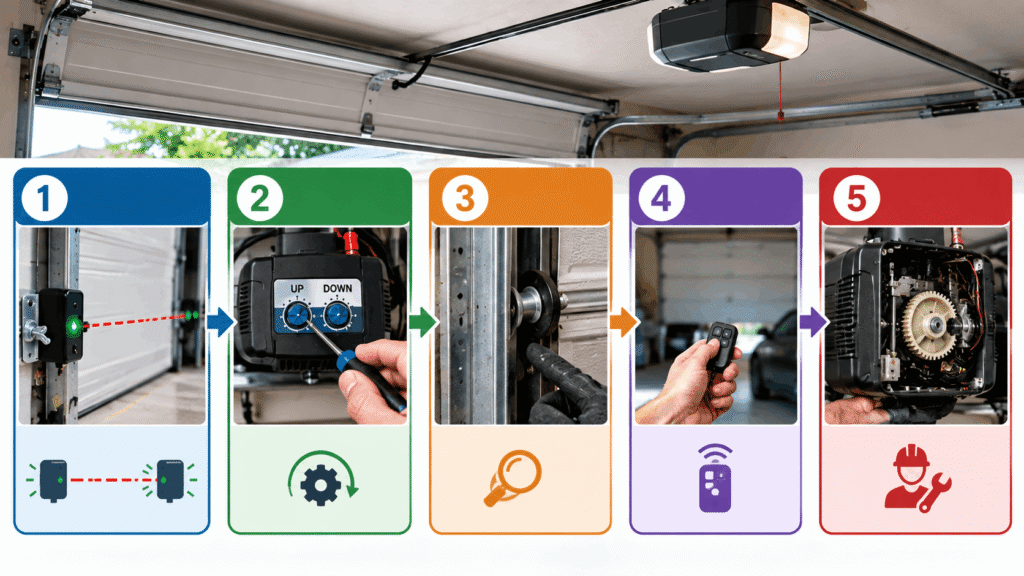
Save or screenshot this decision tree — it walks you through the exact same order a technician would use on a service call, so you skip the guesswork.
- Door won’t close or reverses before closing?
- Check sensor alignment and clean the lenses. Solid LED light on both sensors? → If yes, go to step 2. If still misaligned, adjust and retest.
- Sensors aligned but door still won’t complete its cycle?
- Check the limit switch/travel settings. Adjust down-travel in quarter-turn increments and retest.
- Limit switches correct but door hesitates or reverses mid-cycle?
- Inspect the track for obstructions, bent rails, or loose rollers. Clear debris and retest.
- Door opens or closes without you pressing anything?
- Remove batteries from all remotes. Behavior stops? The remote or wall panel is the cause. Behavior continues? Move to step 5.
- None of the above resolved it, or you hear grinding/clicking?
- This points to gear wear or a wiring fault inside the motor housing. Call a professional rather than opening the unit yourself.
Is This a Safety Risk?
Yes — a garage door opener malfunction is a genuine safety issue, which is exactly why federal regulators mandated the sensor system in the first place.
According to the U.S. Consumer Product Safety Commission, federal rules tied to the Consumer Product Safety Improvement Act of 1990 require every residential garage door opener sold in the United States since January 1, 1993 to include a secondary entrapment-protection device — either a photoelectric sensor pair or a contact-sensing door edge. The CPSC’s earlier proposed rule also recommends testing the reversing feature monthly by placing a solid object in the door’s path and confirming the door reverses on contact.
If your door is stopping or reversing unpredictably, that’s the safety system doing its job — don’t disable it or bypass the sensors to “make the door close.” If your door is opening on its own overnight, unplug the opener at the wall until you’ve isolated the cause, and operate the door manually using the release cord in the meantime.
How to Reset Your Garage Door Opener
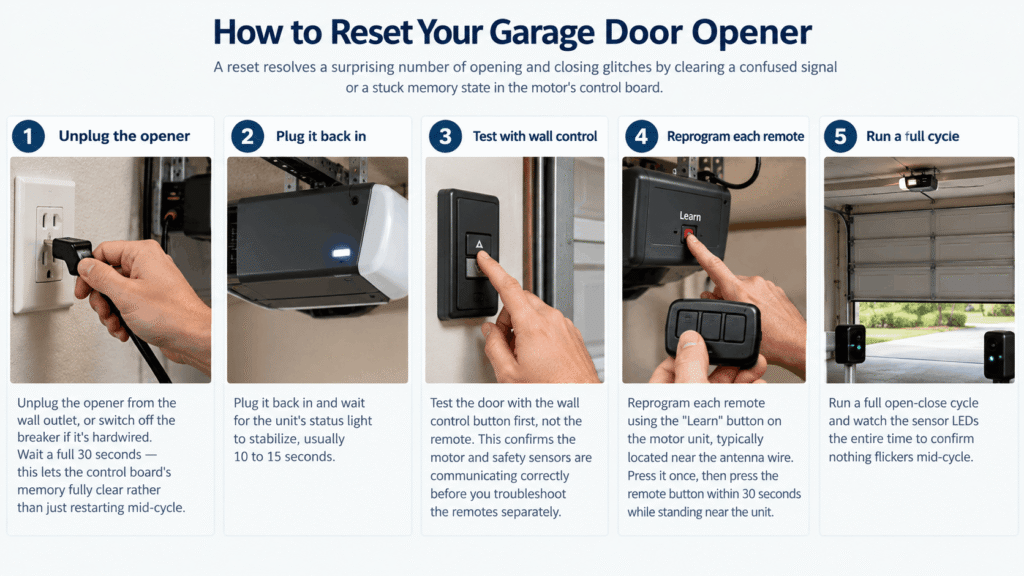
A reset resolves a surprising number of opening and closing glitches by clearing a confused signal or a stuck memory state in the motor’s control board.
- Unplug the opener from the wall outlet, or switch off the breaker if it’s hardwired. Wait a full 30 seconds — this lets the control board’s memory fully clear rather than just restarting mid-cycle.
- Plug it back in and wait for the unit’s status light to stabilize, usually 10 to 15 seconds.
- Test the door with the wall control button first, not the remote. This confirms the motor and safety sensors are communicating correctly before you troubleshoot the remotes separately.
- Reprogram each remote using the “Learn” button on the motor unit, typically located near the antenna wire. Press it once, then press the remote button within 30 seconds while standing near the unit.
- Run a full open-close cycle and watch the sensor LEDs the entire time to confirm nothing flickers mid-cycle.
Common Mistakes to Avoid
- Spraying WD-40 on the gears or track. It attracts dust and grime, which makes limit switch and sensor problems worse over time. Use a silicone-based garage door lubricant instead.
- Increasing the force setting to “fix” a door that won’t close. This overrides the safety reversal system rather than solving the underlying sensor or track problem, and it’s exactly the shortcut the CPSC rule was written to prevent.
- Ignoring a single blinking sensor light because “it worked yesterday.” Sensor drift is usually gradual — a light that blinks intermittently today often fails completely within days.
- Assuming a self-opening door means the opener is broken. In most cases it’s a stuck remote button or a wiring fault, both of which are far cheaper and faster to fix than a full opener replacement.
Most homeowners can resolve every cause on this list except gear wear without calling anyone — but if you’ve worked through sensors, limit switches, and the track and the door still won’t behave, it’s time for a professional inspection rather than more guesswork. The Garage Door Opener Troubleshooting Guide is worth bookmarking for the next time this happens, since these issues tend to recur once a year as brackets loosen and gears age.
When to Call a Professional vs. DIY
Sensor alignment, remote issues, and minor track debris are safe DIY fixes; anything involving the springs, cables, or the motor’s internal gears calls for a licensed technician.
The cost of misjudging this isn’t just a wasted afternoon — garage door springs and cables are under enough tension to cause serious injury if mishandled. If you’ve ruled out sensors, limit switches, and track obstructions and the door is still misbehaving, or if you hear grinding, see fraying cables, or notice the door won’t stay open on its own, stop and call a technician.
FAQs
Why is my garage door opener constantly opening and closing?
This usually means a remote control is stuck sending a signal, a wall control panel has a wiring fault, or nearby radio interference is triggering the receiver. Remove batteries from every remote in the house first; if the cycling stops, the remote is the cause. If it continues, the wall unit’s wiring needs inspection.
Why is my garage door not opening and closing properly?
The most common cause is misaligned safety sensors, followed by incorrect limit switch settings and track obstructions. Check the sensor LED lights first, since a blinking light almost always points directly to the fix.
What are the most common problems with garage door openers?
In order of frequency: sensor misalignment, limit switch or travel setting errors, obstructions in the track, and worn drive gears. The diagnostic table earlier in this guide walks through each one with its typical symptom and fix difficulty.
How do I reset my garage door opening and closing settings?
Unplug the opener for a full 30 seconds, plug it back in, and test with the wall button before the remote. Reprogram each remote using the motor unit’s “Learn” button if the wall button works but the remotes don’t.
Is a garage door opening or closing by itself dangerous?
Yes. A door that moves unexpectedly can trap a person, pet, or vehicle. Unplug the opener at the wall and operate the door manually with the release cord until you’ve identified and fixed the cause.
What to Do Next
If your sensors checked out fine but you’re still stuck, the full Garage Door Opener Troubleshooting Guide covers additional failure points beyond opening and closing behavior. If your opener is making unusual sounds during any of this, Garage Door Opener Making Noise But Not Moving? breaks down that specific symptom. And if you suspect your remote’s battery is the culprit behind phantom signals, Are Garage Door Openers Battery Powered? explains exactly which components run on battery power versus hardwiring.
Pingback: Garage Door Opener No Power but Outlet Works? 7 Fixes