
Your old opener is straining, reversing on its own, or you’re staring at a wall of HP numbers at the store with no idea which one matches your door. Getting this wrong means a motor that burns out in two years or money spent on power you’ll never use. Here’s exactly how to match opener size to your door.
Quick Answer: Most single garage doors need a 1/2 HP opener; most double (2-car) doors need 3/4 HP. Heavy doors — wood, insulated, or oversized — often need 3/4 HP to 1 1/4 HP. Door weight and material matter more than door count, so measure before you buy.
Table of Contents
What You Need to Know
- 1/2 HP suits standard single steel doors up to about 7 feet wide.
- 3/4 HP is the safest default for double doors or any single door that’s insulated or wood.
- 1 1/4 HP (or the DC-motor equivalent) is for oversized, custom, or unusually heavy doors.
- Undersizing strains the motor and shortens its life; oversizing just costs more upfront with no downside.
- Door material changes the math as much as door width does — a wood double door can outweigh a steel double door by a wide margin.
1/2 HP vs. 3/4 HP vs. 1 1/4 HP: What’s the Real Difference?
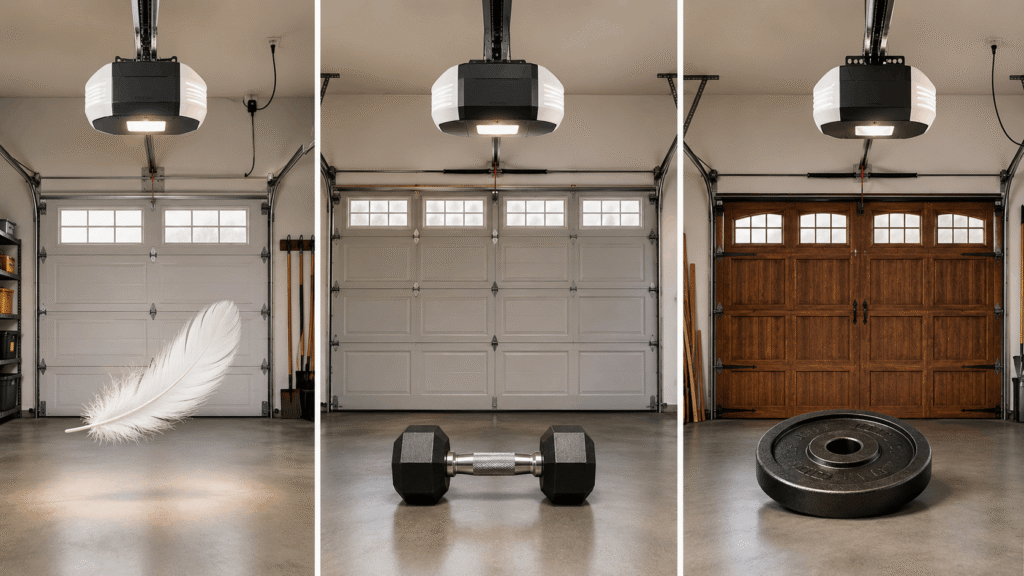
The difference between these three tiers comes down to how much door weight the motor can lift and hold without straining. A 1/2 HP opener is built for lighter, standard doors — not for anything oversized or heavy-material.
A 1/2 HP unit is the standard choice for a single steel door in typical residential dimensions. Push it beyond that — a wider single door, or any door with added insulation — and the motor works harder every cycle, which shows up over time as slower opens, more noise, and earlier failure.
A 3/4 HP opener is the middle tier and, for most double-door households, the safer default. It has meaningfully more lifting reserve, which matters most on colder days when door hardware stiffens and the motor has to work harder to get moving.
How Much Weight Can a 3/4 HP Opener Lift?
A 3/4 HP opener is generally built to handle standard double doors and heavier single doors without straining under normal use. Manufacturers publish exact lift-capacity figures for each model — check the spec sheet for your specific opener rather than assuming, since capacity varies by drive type and brand. [DATA MISSING: exact lb-capacity figures need to come from a specific manufacturer spec sheet before this section is finalized for publication.]
Do I Need a 1 1/4 HP Opener?
Only if your door falls outside standard dimensions or standard materials. A 1 1/4 HP opener (or its DC-motor equivalent, since many newer openers rate horsepower differently than older AC models) is meant for oversized single doors, heavy wood doors, or double doors with thick insulation. If your door is a stock steel double door, 3/4 HP almost always covers it — jumping to 1 1/4 HP is rarely necessary and adds cost without adding benefit.
Does Door Material Change the Answer?
Yes, more than most buyers expect. Two doors of the same width can need two different HP tiers if their materials differ.
- Steel doors (single-layer, non-insulated) are the lightest option and the easiest to size — they’re what the 1/2 HP and 3/4 HP guidelines above assume by default.
- Insulated steel doors add a foam core between two steel layers. That core adds real weight, which is why an insulated double door often needs 3/4 HP even when a non-insulated double door of the same width might get by on less.
- Wood doors are the heaviest common option by a wide margin. A solid wood double door can push you toward 3/4 HP or higher even in a size where steel would only need 1/2 HP.
How to Measure Your Door Before You Buy
- Measure the width in feet at the widest point. Standard singles run 8–9 feet; standard doubles run 16 feet. Confirm yours instead of assuming — custom doors run wider.
- Check the door’s weight rating. Many manufacturers stamp this on the inside of the door or list it in the installation paperwork. If you can’t find it, use the material as your guide: steel < insulated steel < wood.
- Note the drive type you’re replacing, if any. Chain, belt, and screw drives are rated for horsepower differently than direct-drive DC motors — cross-check the new opener’s spec sheet against the door weight, not just the HP number on the box.
- Round up if you’re between tiers. If your door sits right at the edge of a steel double and an insulated double, the 3/4 HP unit is the safer buy.
Save or screenshot this measuring checklist — it covers everything you need before walking into a store or placing an online order.
What Happens If You Get the Wrong Size?
An undersized opener has to work harder on every single cycle. Over months, that shows up as a motor that runs hot, a door that opens more slowly than it used to, or an opener that reverses partway up because it can’t sustain the lift. Left unaddressed, it shortens the motor’s working life significantly.
An oversized opener doesn’t cause functional problems — a 3/4 HP unit on a light steel single door will run fine indefinitely. The only real cost is spending more upfront for lifting capacity the door will never use.
Common Mistakes When Sizing a Garage Door Opener
- Sizing by door count instead of door weight. Two double doors aren’t automatically the same HP need — a steel double and a wood double are different jobs.
- Copying the old opener’s HP without checking if it was ever right. If the last opener struggled, matching its rating just repeats the mistake.
- Ignoring insulation. Buyers measure width and stop there, missing that insulated doors weigh noticeably more than bare steel.
- Assuming HP ratings are identical across brands. AC and DC motors rate horsepower differently — compare lift capacity in pounds when you can, not just the HP number on the box.
When to Call a Professional Instead of Guessing
This guide covers standard residential single and double doors in common materials. If your door is custom-built, unusually large, or you’re not confident reading its weight rating, a measured quote from an installer is worth the cost — an incorrectly sized opener installed on a heavy custom door is a safety issue, not just a performance one.
Get the exact lift specifications for any opener model directly from the manufacturer before buying, since published capacities vary by drive type.
What to Do Next
You now know which HP tier fits your door. Three logical next steps, depending on where you are in the buying process:
If you want to nail down your exact horsepower number — go deeper with the full garage door opener horsepower guide, which breaks down how HP ratings are actually calculated instead of just which tier to pick.
If you’re still deciding between drive types — chain, belt, and screw drives all pair differently with each HP tier. The garage door opener motor types guide walks through how that choice affects noise and lift performance.
If you’re ready to compare actual openers — see how the full range stacks up in the garage door opener types comparison now that you know your sizing tier.
FAQs
Should I get a 1/2 or 3/4 HP garage door opener?
Choose 1/2 HP for a standard single steel door under about 7 feet wide. Choose 3/4 HP for double doors, insulated doors, or any single door that’s heavier than standard steel. When your door sits between the two, 3/4 HP is the safer pick — it costs a bit more but won’t strain under normal use.
How much weight can a 3/4 HP garage door opener lift?
A 3/4 HP opener is built to handle standard double doors and heavier single doors without strain. Exact lift capacity in pounds varies by manufacturer and drive type, so check the specific model’s spec sheet rather than relying on the HP number alone.
Do I need a 1 1/4 HP garage door opener?
Only for oversized doors, heavy wood doors, or thickly insulated double doors that exceed standard dimensions. A stock steel or standard insulated double door is almost always covered by 3/4 HP, making 1 1/4 HP unnecessary for most households.
How big does my garage door opener need to be?
Size your opener to your door’s weight and width together, not width alone. Standard single steel doors typically need 1/2 HP, standard double doors typically need 3/4 HP, and anything oversized or unusually heavy — wood, thick insulation, custom dimensions — should move up a tier.
Does the type of door drive (chain, belt, screw) affect what size I need?
Drive type affects noise and smoothness more than raw lifting power, but HP ratings aren’t always directly comparable across drive types and motor styles (AC vs. DC). Compare published lift capacity in pounds when choosing between openers, not just the horsepower label.
Pingback: Average Cost of a Garage Door Opener (2026 Price Guide)