
You press the remote and nothing happens. Or the door starts closing, stops halfway, and slides back up like it changed its mind. Most of the time, the fix takes less time than it took you to get annoyed about it.
Quick Answer: The most common garage door opener problems are dead remote batteries, misaligned or dirty photo-eye sensors, incorrect travel-limit settings, a disconnected trolley, and motor or circuit board failure. Most of these can be diagnosed in under five minutes by checking power, the sensors, and the manual disconnect before you call a technician.
Table of Contents
What You Need to Know
- Roughly half of “broken opener” calls trace back to something that isn’t broken at all — dead batteries, a bumped lock switch, or a dirty sensor lens.
- Photo-eye sensors have been legally required on U.S. garage door openers since 1993, and they’re the single most common cause of a door that won’t close.
- Springs, cables, and circuit boards are the three components you should never attempt to repair yourself.
- A door that reverses partway is doing exactly what it’s designed to do — the sensor thinks something is in the way, even when nothing is.
- Smart openers with battery backup (myQ, Chamberlain, LiftMaster) add a new failure point that older systems don’t have.
Is It the Opener or the Door? A 60-Second Test
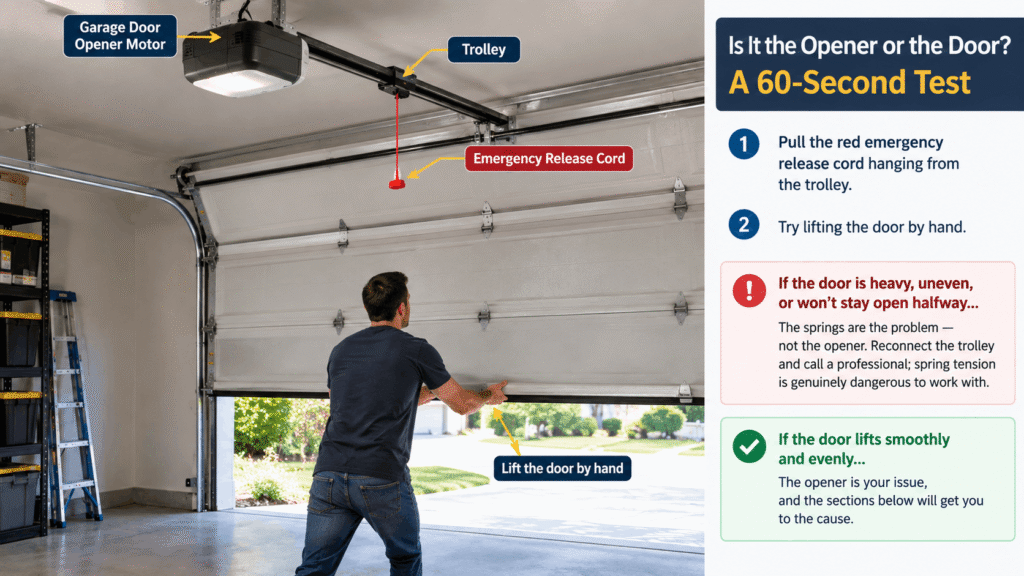
Before you troubleshoot the opener itself, confirm the problem isn’t the door. Pull the red emergency release cord hanging from the trolley and try lifting the door by hand.
If the door is heavy, uneven, or won’t stay open on its own halfway up, the springs are the problem — not the opener. According to the U.S. Consumer Product Safety Commission’s garage door safety guidance, a properly balanced door should stay in place when stopped in any partially open position; one that crashes down or won’t hold is a spring or balance issue. Reconnect the trolley and call a professional; spring tension is genuinely dangerous to work with.
If the door lifts smoothly and evenly by hand, the opener is your issue, and the sections below will get you to the cause.
1. Opener Doesn’t Respond to the Remote or Keypad
The remote or keypad sends a signal the opener isn’t receiving, and dead batteries cause this more often than any other single issue.
Start with the wall-mounted button inside the garage. If that opens the door normally, the problem is isolated to the remote — not the opener’s motor or circuit board.
- Step 1: Replace the remote’s battery, matching polarity to the diagram inside the compartment.
- Step 2: Test from inside the garage, standing within 10 feet of the unit.
- Step 3: If it still fails, check the opener’s antenna — it should hang straight down from the motor housing, not be tucked up out of the way.
- Step 4: If nothing works, hold the “learn” button on the motor unit for 2–3 seconds until the indicator light blinks, then press the remote button once to re-pair it.
2. Opener Hums or Runs But the Door Doesn’t Move
This almost always means the trolley has disconnected from the drive carriage, not that the motor is failing.
If you hear the motor running for its usual cycle time but the door stays put, look at the cord hanging from the trolley. Pulling it disengages the door from the opener — useful during a power outage, but it’s easy to bump loose accidentally.
Pull the cord toward the motor to re-engage the trolley, then run the door through a full open-close cycle to confirm it re-locked into the carriage. If the trolley is engaged and the door still doesn’t move, the motor’s drive gear may be stripped, which is a repair job, not a DIY one.
Why Is My Garage Door Opener Not Working? (Intermittent Failures)
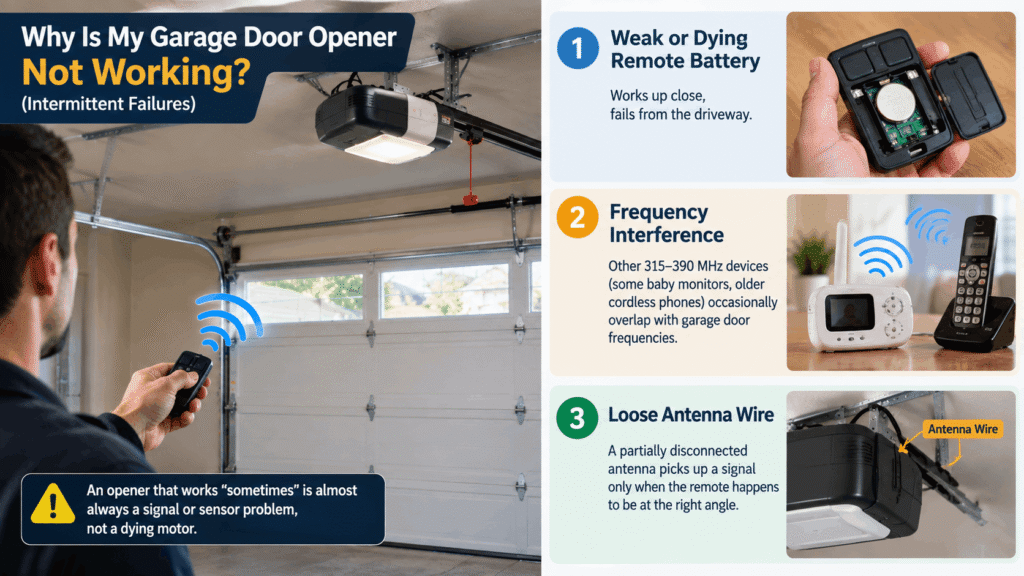
An opener that works “sometimes” is almost always a signal or sensor problem, not a dying motor.
Intermittent failure is more frustrating to diagnose than a total failure because the cause isn’t constant. The three usual suspects:
- Weak or dying remote battery — works up close, fails from the driveway.
- Frequency interference — other 315–390 MHz devices (some baby monitors, older cordless phones) occasionally overlap with garage door frequencies.
- Loose antenna wire — a partially disconnected antenna picks up a signal only when the remote happens to be at the right angle.
Rule out the battery first since it’s the cheapest fix, then test from a fixed, close distance for a full week to see if the failures cluster at certain times of day (a sign of interference) or seem random (a sign of a wiring fault).
3. Door Reverses or Stops Partway Through Closing
Federal safety standards have required an external entrapment-protection sensor on every U.S. garage door opener made since January 1, 1993, and a blocked or misaligned sensor is the top reason doors reverse.
The two photo-eye sensors sit about 4–6 inches off the garage floor, one on each side of the door track, aimed directly at each other. If anything breaks that invisible beam — a bike, a dropped tool, spiderwebs, or even direct sunlight hitting the receiver at a certain time of day — the opener assumes something is in the door’s path and reverses it.
Wipe both lenses with a soft, dry cloth first. If the door still reverses, check that both sensor brackets sit at the same height; a bracket bumped by a car bumper or a stored ladder is a frequent cause. For a deeper look at doors that specifically stop halfway and reverse, see our full breakdown of why your garage door goes down halfway then back up.
4. Opener Makes Loud Grinding or Straining Noise
Grinding, straining noise almost always points to friction or an out-of-balance door, not the motor itself failing.
A healthy opener makes a consistent hum. A grinding, screeching, or straining sound usually means the motor is working harder than it should — often because the door itself is fighting the springs rather than moving freely with them.
Lubricate the rollers, hinges, and track with a silicone-based spray (not WD-40, which is a solvent and evaporates quickly rather than lubricating long-term). If the noise persists after lubrication, the door may be out of balance, which strains the opener every cycle it runs. We cover this specific noise pattern in more detail in garage door opener making noise but not moving.
5. Travel Limit Settings Are Off
The opener’s travel limits tell it exactly how far to move before it should stop, and settings that drift over time are a common cause of a door that won’t fully open or close.
If the door reverses immediately after touching the floor, or stops a foot short of fully open, the limit switch — not the sensors — is usually the cause. Most openers have small adjustment screws or a digital menu on the motor unit itself; consult your model’s manual for the exact dial or button sequence, since this varies by brand and generation.
6. Dead or Draining Backup Battery (Smart and Newer Openers)
Openers manufactured to meet current UL 325 standards include a battery backup, and a drained one is a growing cause of “random” failures during storms or outages that older opener guides don’t cover.
If your opener has a battery backup (common on Chamberlain, LiftMaster, and Genie models from the last several years), a failing backup battery can cause the unit to behave erratically even while plugged in — flickering lights, delayed response, or a full failure to open during a power blip. These batteries typically need replacement every 2–3 years even if the opener is otherwise fine.
7. Motor or Circuit Board Failure
When you’ve ruled out batteries, sensors, the trolley, and limit settings, and the opener still won’t run at all, the motor or circuit board is the remaining cause — and this is where professional repair earns its cost.
Check that the unit is plugged into a live outlet and that the circuit breaker for the garage hasn’t tripped. If power is confirmed and the opener still shows no signs of life, or runs but trips the breaker repeatedly, the internal motor or control board has failed. This isn’t a DIY repair; a technician can tell you whether it’s cheaper to repair the board or replace the entire unit.
Symptom → Cause → Fix Quick-Reference Chart
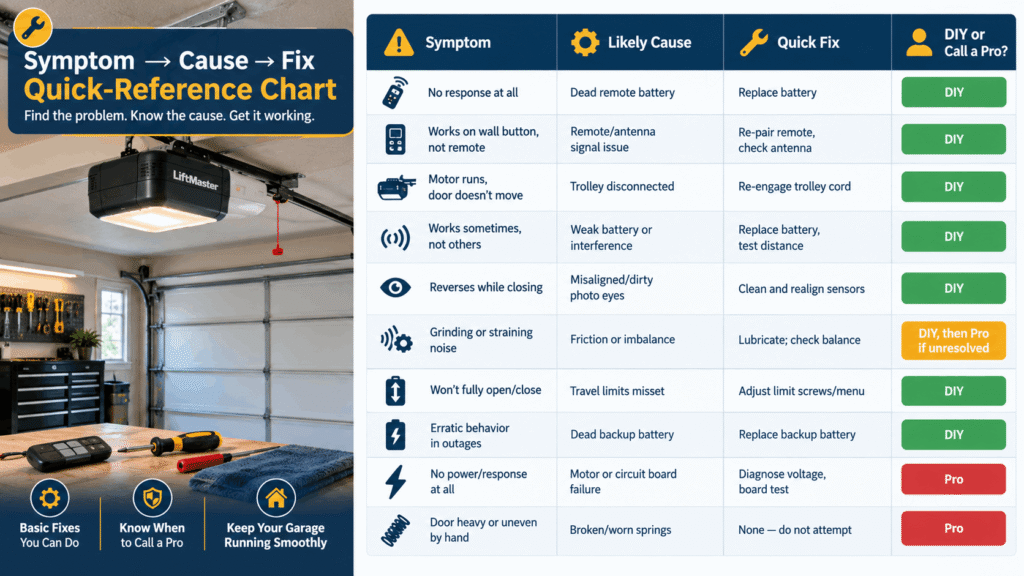
| Symptom | Likely Cause | Quick Fix | DIY or Call a Pro? |
|---|---|---|---|
| No response at all | Dead remote battery | Replace battery | DIY |
| Works on wall button, not remote | Remote/antenna signal issue | Re-pair remote, check antenna | DIY |
| Motor runs, door doesn’t move | Trolley disconnected | Re-engage trolley cord | DIY |
| Works sometimes, not others | Weak battery or interference | Replace battery, test distance | DIY |
| Reverses while closing | Misaligned/dirty photo eyes | Clean and realign sensors | DIY |
| Grinding or straining noise | Friction or imbalance | Lubricate; check balance | DIY, then Pro if unresolved |
| Won’t fully open/close | Travel limits misset | Adjust limit screws/menu | DIY |
| Erratic behavior in outages | Dead backup battery | Replace backup battery | DIY |
| No power/response at all | Motor or circuit board failure | Diagnose voltage, board test | Pro |
| Door heavy or uneven by hand | Broken/worn springs | None — do not attempt | Pro |
Save or screenshot this chart — it covers all nine opener problems in one place, so you don’t have to scroll back through the article next time something acts up.
Does This Vary by Opener Type? Chain vs. Belt vs. Screw Drive
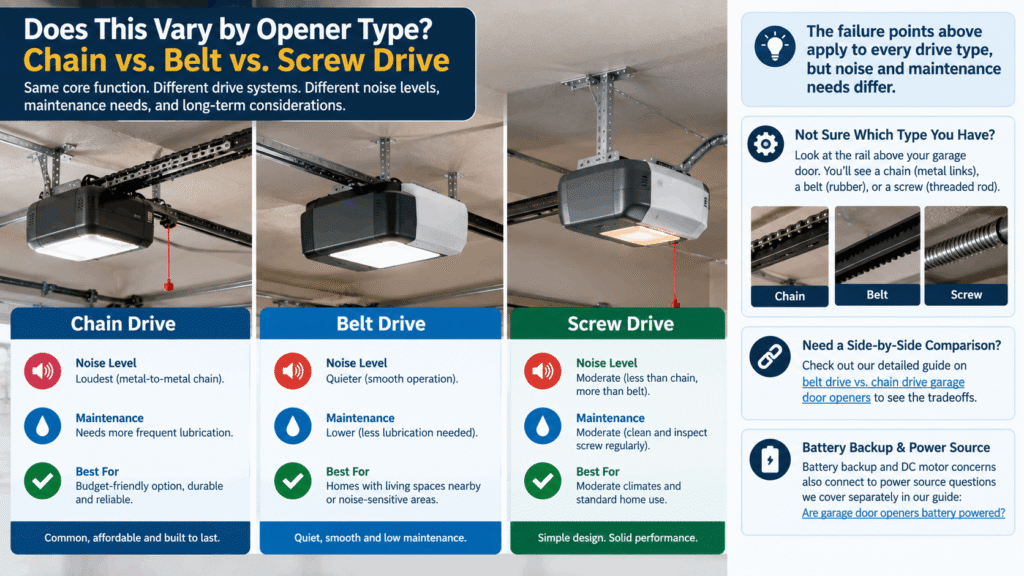
The failure points above apply to every drive type, but noise and maintenance needs differ. Chain-drive openers are the loudest and need more frequent lubrication; belt-drive units run quieter but the belt itself can fray over years of use. If you’re not sure which drive type you have or you’re weighing a replacement, our comparison of belt drive vs. chain drive garage door openers breaks down the tradeoffs.
Battery backup and DC motor concerns also connect to power source questions we cover separately in are garage door openers battery powered?
DIY Fix or Call a Professional?
Batteries, sensor cleaning, trolley re-engagement, lubrication, and limit adjustments are all reasonable DIY tasks with basic tools. Springs, cables, and circuit board repair are not. Garage door springs store enough tension to cause serious injury, which is part of why the U.S. Consumer Product Safety Commission’s safety standard for automatic residential garage door operators mandates entrapment-protection systems in the first place. If a fix involves the spring, the cable drums, or opening the motor housing, that’s a professional’s job.
The entrapment-protection requirement isn’t just paperwork — according to UL’s own review of the standard, incidents, fatalities, and entrapments have dropped by more than 50% as a share of all garage door injuries since the dual-sensor requirement took effect. It’s also worth testing that safety reversal yourself: the CPSC recommends placing a roll of paper towels in the door’s path once a month and confirming the door reverses within two seconds of touching it.
Common Mistakes People Make Troubleshooting Openers
- Spraying WD-40 on the track or rollers. It’s a solvent, not a lubricant — it washes out old grease and leaves parts drier within weeks.
- Assuming a reversing door means the opener is broken. Nine times out of ten it’s a sensor being blocked or misaligned, not a mechanical fault.
- Adjusting travel limits repeatedly without finding the root cause. If limits keep drifting, something else — often a loose bracket — is the real problem.
- Opening the motor housing to “check the circuit board.” This voids most warranties and risks injury from stored capacitor charge.
Preventing Future Opener Problems
A few minutes of maintenance twice a year — cleaning the sensor lenses, lubricating the track, and testing the auto-reverse function — prevents most of the problems above from happening in the first place. If your opener is more than 10–12 years old and you’re replacing the same part for the third time, replacing the whole unit is often cheaper over a two-year horizon than continued repair calls.
(We’re building a full buying guide to help you compare current opener models when that time comes — check back soon.)
FAQs
How do I diagnose garage door opener problems?
Start with the emergency release test: disconnect the trolley and lift the door by hand. If it’s heavy or uneven, the problem is the door’s springs, not the opener. If it lifts smoothly, work through power, remote batteries, photo-eye alignment, and travel limits in that order — in that sequence, you’ll catch about 90% of causes without tools.
How do I know if my garage door opener is bad?
An opener is likely failing — not just misconfigured — if it won’t respond at all even with fresh batteries and a confirmed power source, if it trips the circuit breaker repeatedly, or if the motor runs but makes a grinding sound from inside the housing itself rather than from the door hardware. Those point to internal motor or circuit board damage.
What are the most common garage door opener repairs?
The most frequently reported repairs are remote/keypad battery and signal issues, photo-eye sensor cleaning and realignment, travel-limit adjustment, trolley re-engagement, and motor or circuit board replacement. Spring and cable repairs are common too, but those belong to the door itself rather than the opener unit.
Why does my garage door opener work sometimes and sometimes not?
Intermittent failure is typically caused by a weakening remote battery, occasional radio-frequency interference from another nearby device, or a loose antenna connection that only makes contact at certain angles. Testing at a fixed, close distance over several days usually reveals which of the three it is.
How long do garage door openers typically last?
Most residential garage door openers last 10–15 years with regular maintenance. Chain-drive units tend to run a few years longer than belt-drive units simply because there’s less to wear out, though belt drives are quieter throughout their lifespan — see our belt vs. chain drive comparison if noise level matters more to you than lifespan.
What to Do Next
If your door is reversing partway through closing, our dedicated guide on why your garage door goes down halfway then back up walks through the sensor fix in more depth. If noise is your main symptom, garage door opener making noise but not moving covers that specifically. And if you’re trying to decide between drive types before replacing an aging unit, start with belt drive vs. chain drive garage door openers.
Pingback: Garage Door Remote Not Working But Wall Button Does?