
You heard it before you saw it — a metallic slap or rattle every time the door runs, and now you’ve noticed the chain sagging where it should be pulled snug against the rail. That’s one of the most common chain-drive opener problems, and in most cases you can fix it yourself in under 15 minutes.
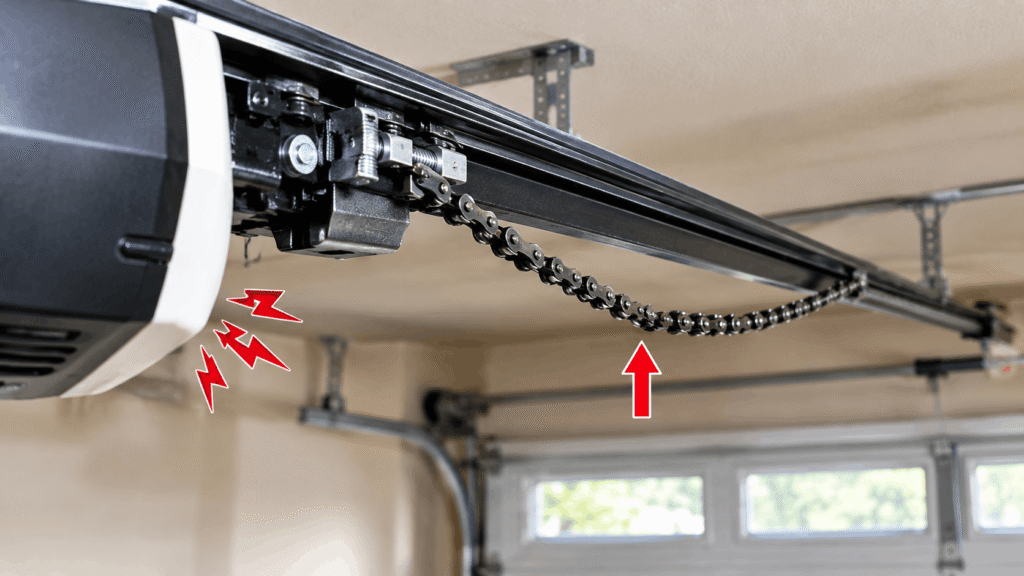
Quick Answer: A loose garage door opener chain is usually just normal chain stretch from months of use, not a failing opener. Fix it by finding the tension adjustment nut on the trolley near the rail’s front, then turning it in small increments until the chain has about ¼ to ½ inch of slack at the midpoint — never pull it drum-tight.
Table of Contents
What You Need to Know
- A loose chain almost always comes from normal wear, not a broken opener.
- The chain should have a small amount of play — about ¼ to ½ inch of sag at the midpoint. Perfectly taut is actually a mistake.
- Tightening it takes one wrench and about 15 minutes, done with the power unplugged.
- A chain that keeps re-loosening or skips off the sprocket after adjustment is a sign to call a professional.
- A loose chain and a loose cable are two different parts of the system — don’t apply chain advice to a cable problem.
Why Is My Garage Door Opener Chain Loose?
Garage door chains loosen mainly because metal chain links stretch gradually with repeated use, the same way a bicycle chain does over thousands of cycles. Vibration from daily operation, seasonal temperature swings that expand and contract metal, and a worn drive sprocket all speed this up. A chain that was slightly under-tensioned at installation will also work its way looser faster than one that was set correctly from day one.
This is routine maintenance, not a sign your opener is failing. Most chain-drive openers need a tension check at least once a year, more often if the door gets heavy daily use.
Signs Your Chain Tension Is Off
You don’t need to remove anything to check for a loose chain. Look and listen for:
- Visible sag — the chain hangs noticeably below the rail housing when the door is closed
- Slapping or rattling — a metallic clatter as the trolley moves, loudest right when the motor starts or stops
- Jerky or uneven door movement — the door hesitates, jumps, or slows partway through its travel
- The chain riding up over the sprocket teeth — in bad cases, it can skip or jump off entirely
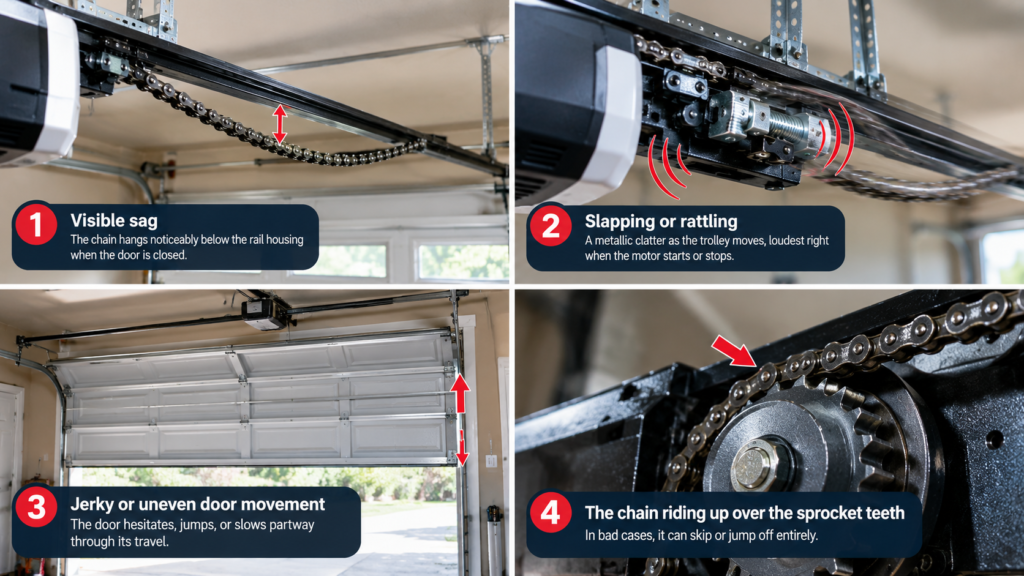
If you’re seeing more than one of these at once, tension is very likely the cause.
How Tight Should a Garage Door Chain Be?
The correct amount of slack is about ¼ to ½ inch measured at the chain’s midpoint — the point on the rail farthest from both the opener motor and the door header. That’s roughly the width of two stacked quarters. This range shows up consistently across chain-drive opener manuals from major brands like Chamberlain, LiftMaster, and Genie, because the underlying mechanics are the same across brands.
Too little slack (less than about ⅛ inch) forces the chain to grind against the sprocket under constant load, which wears out both the chain and the motor faster. Too much slack (more than ¾ inch) lets the chain whip and slap, and eventually risks jumping the sprocket teeth. The goal is snug, not rigid.
How to Tighten a Loose Garage Door Opener Chain
You’ll need a wrench (usually 7/16″ or ½”, depending on your opener model), work gloves, and a stepladder if your opener is mounted high. The whole adjustment takes about 10 to 15 minutes.
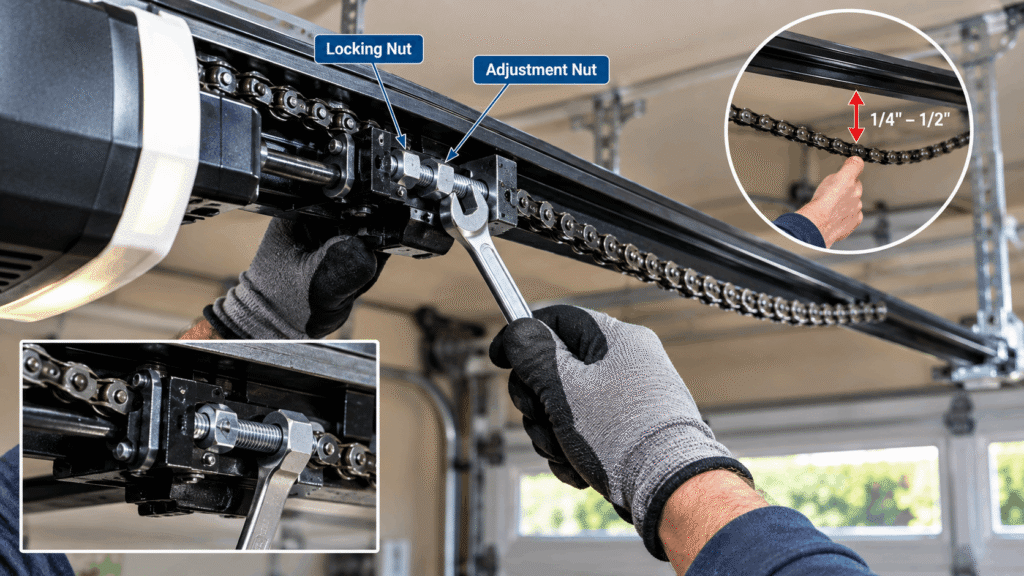
- Unplug the garage door opener from its power outlet. Never adjust the chain with the motor powered — an accidental cycle while your hands are near the trolley is a real injury risk.
- Close the garage door fully. This gives you a consistent, repeatable position to measure and adjust from.
- Locate the tension adjustment assembly on the trolley, near the front of the rail. Look for a threaded rod running through a bracket, held by two nuts: a locking nut and an adjustment nut.
- Loosen the locking nut with your wrench, turning it counterclockwise just enough to let the adjustment nut move — don’t remove it completely.
- Turn the adjustment nut clockwise in quarter-turn increments to tighten the chain, or counterclockwise to loosen it if it’s currently too tight.
- Check the sag after every quarter turn. Press gently upward on the chain at its midpoint and measure the gap to the rail — stop once you’re at ¼ to ½ inch.
- Re-tighten the locking nut to hold the adjustment in place, then plug the opener back in.
- Run a full open-and-close cycle and listen. Smooth, quiet travel with no slapping or grinding means you’re done. If you still hear noise, unplug and repeat steps 4–7.
Chains often settle slightly after the first adjustment, so it’s normal to recheck the tension once more after a week of regular use.
Chain Tension Diagnostic Table
| Symptom | Likely Cause | Fix | Urgency |
|---|---|---|---|
| Chain sags more than ¾ inch, slaps against rail | Normal stretch from age/use | Tighten adjustment nut in quarter-turn steps | Fix this week |
| Door jerks or hesitates mid-travel | Chain too loose to grip the sprocket evenly | Retension, then run a full test cycle | Fix this week |
| Chain skips or jumps off the sprocket teeth | Chain loose enough to disengage, or worn sprocket teeth | Retension; inspect the sprocket for wear | Call a pro if it recurs after tightening |
| Loud grinding or metal-on-metal sound | Chain over-tightened, or worn/dry components | Loosen slightly; check chain lubrication | Fix this week |
| Door won’t fully close | Loose chain plus misaligned travel limits | Retension chain, then reset the opener’s travel limits | Call a pro if it doesn’t resolve |
Save or screenshot this diagnostic table — it covers the symptom-to-fix path for nearly every loose-chain complaint without needing to call anyone first.
Want a printable, garage-toolbox version of this table? Join accessifyhome.com’s maintenance tip list and we’ll send you one.
Is a Loose Chain Dangerous?
A loose chain by itself is a wear-and-noise problem, not an acute safety hazard — that distinction matters, because it’s very different from a loose or damaged cable, which is genuinely dangerous. A loose chain mainly stresses the motor, makes the door louder, and can eventually let the chain jump the sprocket.
Where it gets riskier is if you ignore it for a long time: a badly slipping chain can let the door move unevenly or stop mid-cycle, which affects alignment over repeated use. It’s a “fix it soon” issue, not a “stop using the garage today” emergency — unlike a snapped cable or broken spring.
Chain vs. Cable: Don’t Confuse the Two
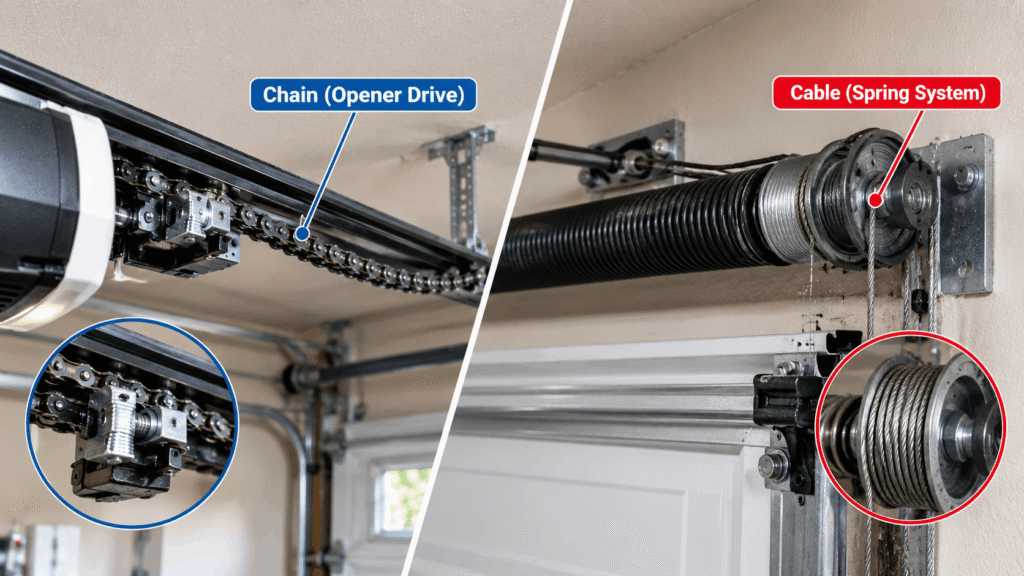
These are two completely different parts of your garage door system, and mixing up advice between them is genuinely risky. The chain connects the opener motor to the trolley that pulls the door — a loose chain is a low-stakes DIY adjustment.
The cables, by contrast, work with the torsion or extension springs to counterbalance the door’s full weight, which can be hundreds of pounds under extreme tension. A loose or slack cable — especially one that’s loose only at the top of the door’s travel, or that appears loose on one side while the other stays tight — is not a DIY fix. If you’re seeing cable slack rather than chain slack, leave it alone and call a professional; the stored spring tension in that system can cause serious injury if it releases unexpectedly.
What to Do If the Chain Falls Off
If the chain has come off the sprocket entirely, unplug the opener first — don’t attempt to reset it while it’s powered. With the door in the closed position, inspect the sprocket and chain for visible damage: bent links, missing teeth on the sprocket, or a chain that’s stretched enough to have extra links than it should.
If there’s no obvious damage, you can often re-seat the chain over the sprocket by hand, then follow the tightening steps above before testing it. If the sprocket teeth are worn smooth, or the chain looks stretched beyond adjustment range, that’s a parts-replacement job better handled by a technician.
Common Mistakes When Tightening a Garage Door Chain
- Over-tightening “to be safe.” A rigid chain wears out the motor and sprocket faster than a slightly loose one — snug is the goal, not rock-hard.
- Forgetting to re-tighten the locking nut. Without it, the adjustment nut will drift back to loose within days of use.
- Adjusting with the door open instead of closed. You’ll get an inconsistent sag reading and may end up over- or under-tightening.
- Skipping the test cycle. Always run the door through a full open-close cycle before considering the job done — a problem that seems fixed at rest can reappear under load.
- Treating a recurring loose chain as a tightening problem only. If it keeps loosening within weeks of adjustment, the real cause is usually a worn sprocket or stretched chain, not your tightening technique.
When to Call a Professional Instead of DIY
Call a garage door technician if the chain re-loosens within a few weeks of a proper adjustment, if it keeps skipping the sprocket teeth after you’ve retensioned it, if you see visible damage to the chain links or sprocket, or if your opener is more than 8–10 years old and showing multiple symptoms at once. Those patterns usually point to worn parts that tightening alone won’t fix. And as covered above, anything involving loose or slack cables should go straight to a professional — that’s spring-tension territory, not a wrench-and-15-minutes job.
FAQs
What happens if the garage door chain is loose?
A loose chain causes noisy, jerky door movement and puts extra strain on the opener motor as it works against slack instead of a taut connection. Left unaddressed, it can let the chain skip off the sprocket teeth, and in worse cases contributes to uneven door travel. It’s a maintenance issue to fix promptly, not an emergency.
How do I tighten a garage door chain?
Unplug the opener, then locate the tension adjustment nut on the trolley near the front of the rail. Loosen the locking nut, turn the adjustment nut clockwise in quarter-turn steps, and recheck the sag after each turn until you reach ¼ to ½ inch of slack at the chain’s midpoint. Re-tighten the locking nut and test a full cycle.
What to do if the garage door chain falls off?
Unplug the opener before touching anything. Check the sprocket and chain for visible damage like bent links or worn teeth. If everything looks intact, you can usually re-seat the chain by hand and then retension it; if the sprocket teeth are worn or the chain looks stretched, call a technician for parts replacement.
Is it normal for a garage door cable to be loose when the door is open?
Not usually, and it shouldn’t be treated the same as a loose chain. A cable that goes slack — especially only at the top of travel, or unevenly on one side — signals a developing imbalance in the spring counterbalance system. That’s a professional-only repair, since the springs involved hold enough tension to cause serious injury.
How often should I check my garage door chain tension?
Check it at least once a year as part of routine garage door maintenance, or sooner if you notice new noise or jerky movement. Doors that cycle multiple times a day, or that see heavy garage use, benefit from a check every six months since the chain stretches faster with more use.
What to Do Next
If tightening the chain didn’t fully quiet things down, your opener may have a broader issue — see Garage Door Opener Making Noise But Not Moving? Here’s Why for the next diagnostic step. If you’re weighing whether a chain-drive setup is even right for you long-term, Belt Drive vs. Chain Drive Garage Door Opener: Which Wins? breaks down the tradeoffs. And if you’re not sure what type of opener you have in the first place, start with Types of Garage Door Openers: A Complete Comparison.
Pingback: Garage Door Opener Smoking? Causes & What to Do Now